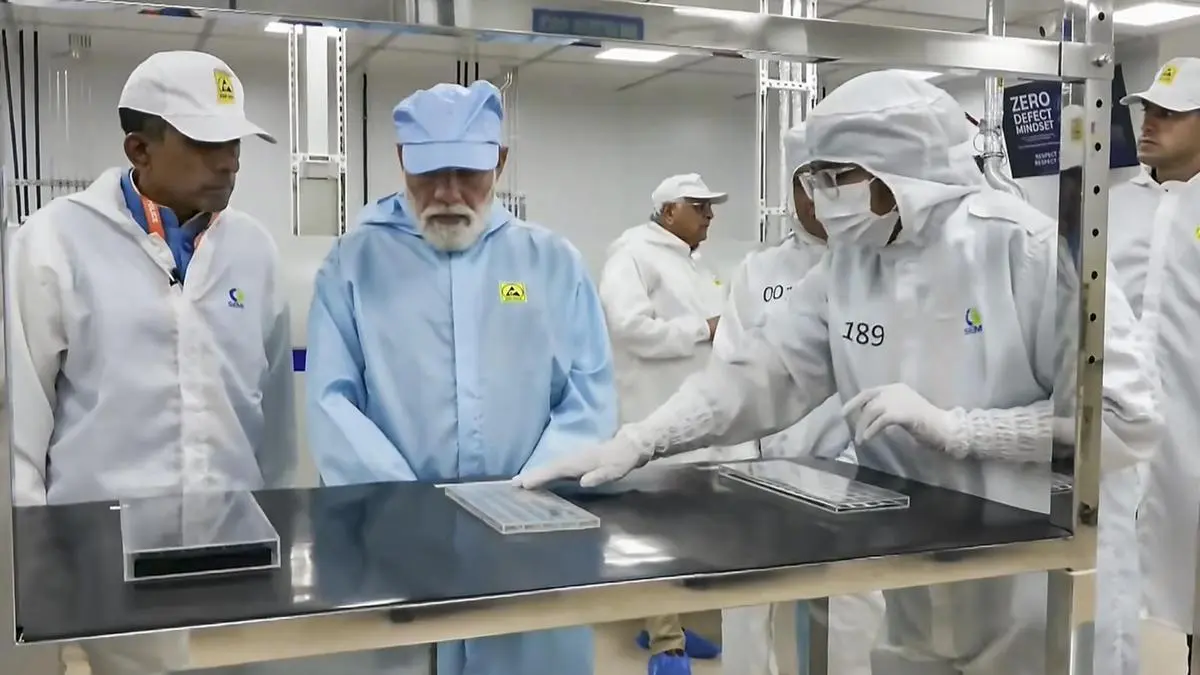
Prime Minister Narendra Modi inaugurated CG Semi's Outsourced Semiconductor Assembly and Test (OSAT) facility at Sanand, Gujarat, on Saturday. The ₹7,500-crore plant is the third semiconductor facility in India to begin commercial production in the past five months, following Micron Technology and Kaynes Semicon in the same industrial zone.
The facility packages chips for automobiles, scooters and industrial equipment, with first shipments going to Japanese partner Renesas Electronics. Over 75 engineers from the Philippines, South Korea, the US and Malaysia relocated to Gujarat to build the plant, chairman Vellayan Subbiah said. They work alongside young women from six Indian states who trained in Malaysia for specialized semiconductor roles.
Spread across 75,000 square feet, the plant can package about 300 million semiconductor units per year. A second facility spanning nearly one million square feet is under construction, targeting capacity of four billion units annually, the minister said.
What an OSAT facility actually does
Semiconductor manufacturing splits into three stages: design, fabrication (fab), and assembly/testing/packaging (OSAT). The fab etches circuits onto wafers; OSAT cuts the wafer into individual chips, attaches leads, encapsulates them in protective material, and tests performance. It is the bottleneck between raw wafers and finished components that can go into electronics. Without OSAT capacity, fabs produce wafers that cannot be sold to end users.
India has no commercial semiconductor fab yet. Tata Electronics is building one at Dholera in Gujarat, targeted for 2026-2027. Meanwhile, the OSAT facilities give India a foothold in the downstream segment of the supply chain. The chips packaged at Sanand are destined for automotive and industrial customers in Japan, the US and Europe.
The cluster logic
PM Modi said back-to-back commissioning of Micron, Kaynes Semicon and CG Semi in Sanand creates a manufacturing cluster that attracts suppliers of specialty chemicals, testing labs, equipment servicers, chip designers and startups. The state has secured six semiconductor projects involving about ₹1.24 lakh crore in investment. Besides the three OSAT plants, Suchi Semicon runs a pilot OSAT in Surat, and Crystal Matrix has approval for a mini and micro-LED display fab at Dholera.
Clusters matter because chip packaging depends on proximity to clean rooms, gas suppliers and precision-tool maintenance. Taiwan's Hsinchu Science Park and South Korea's Gyeonggi cluster grew the same way: one anchor fab draws support industries that reduce lead times and logistics costs for every new entrant.
Readthrough for Micron
Micron Technology, which operates its own OSAT facility in Sanand, is the nearest peer. All three OSAT plants compete and collaborate for the same pool of trained operators, equipment vendors and test-lab capacity. If the CG Semi plant ramps to four billion units as planned, it will pressure Micron's Indian margins in the short term through labor competition but validate the region's viability for global chip customers in the long term. Micron's Alpha Score sits at 69 out of 100, indicating moderate positioning. The stock's next catalyst is the September quarter earnings call, where management is expected to update pricing for DRAM and NAND.
The CG Semi facility also underlines a shift in chip packaging from Southeast Asia to India. The 75 relocated engineers from the Philippines and Malaysia signal that expertise is moving, not just capital. For investors tracking the semiconductor theme, the key metric to watch is utilization rates across the three Sanand OSAT plants over the next 12 months. If all three run above 70%, it will confirm that global packaging demand is shifting, not just testing India as a single-source bet.