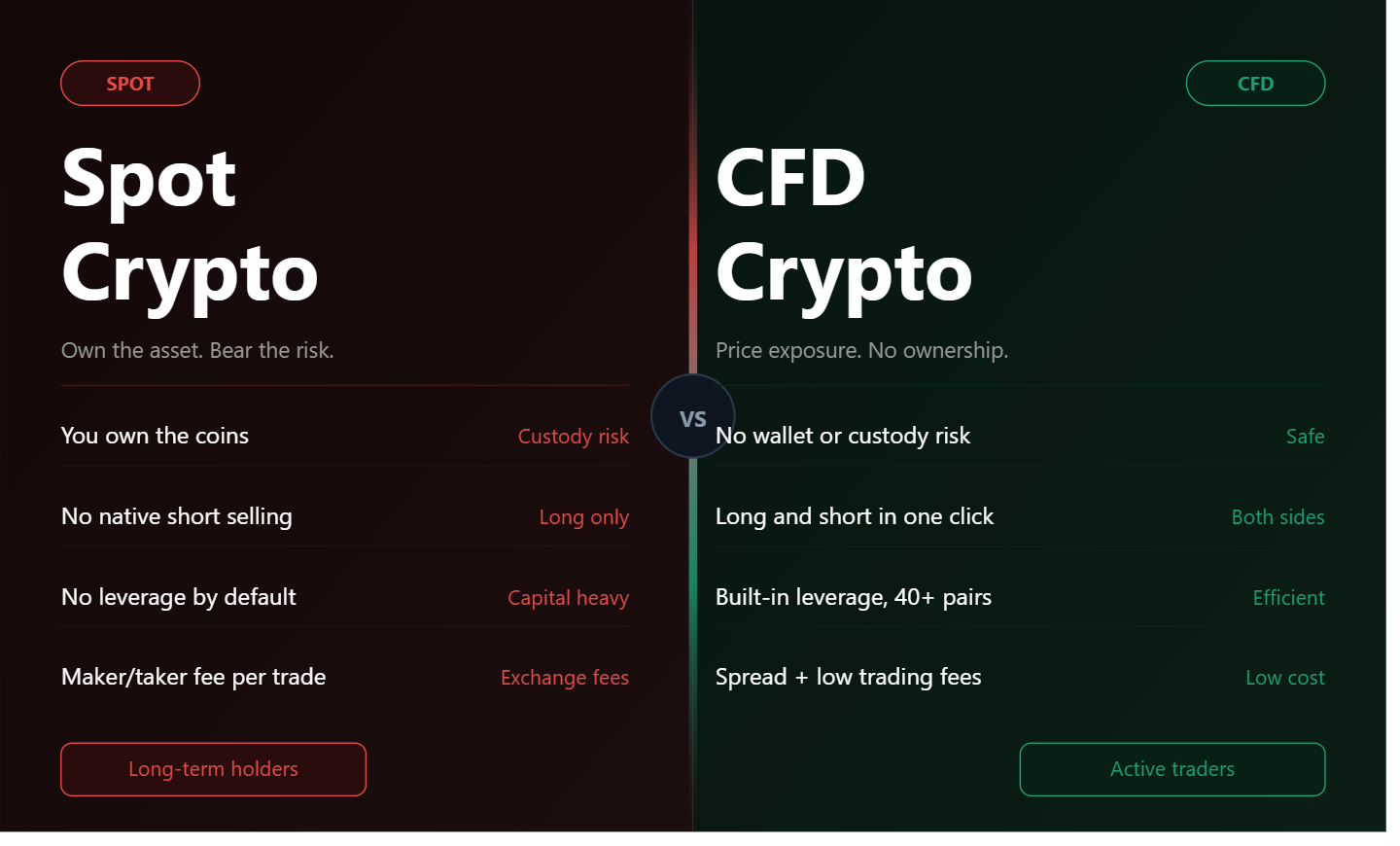
Spot crypto confers ownership and blockchain security; CFDs offer leverage but carry counterparty risk. The choice reshapes liquidation speed and regulatory access.
Traders moving from spot crypto to CFD trading often assume the two differ only in settlement speed. The difference runs deeper. A spot trade transfers ownership of the token. A CFD is a derivative contract between the trader and the broker. That distinction reshapes every component of risk management, from liquidation triggers to regulatory exposure.
This matters now because crypto volatility remains high, and regulatory scrutiny on derivatives is tightening. Choosing the wrong instrument can erase capital faster than a wrong price call.
When you buy Bitcoin on a spot exchange, the token settles on-chain. You can withdraw it to a private wallet and control the private keys. The exchange acts as a custodian during the trade, though you own the asset. If the exchange suffers an outage, the blockchain still holds your balance once withdrawn.
A CFD never touches a blockchain. The broker creates a synthetic position that tracks the underlying price. You pay margin – typically 3% to 5% of the notional value for major pairs – and the broker marks the position to market. No coins move. The counterparty is the broker, not the network.
Settlement risk diverges sharply. A spot position survives an exchange hack if the user holds the coins in a private wallet. A CFD position depends entirely on the broker’s solvency. When a broker becomes insolvent, the contract may not settle at all. The derivative structure embeds that counterparty risk.
Spot margin lending allows a trader to borrow funds against crypto collateral. The exchange sets a loan-to-value ratio, and liquidation occurs when the collateral value drops below the threshold. Some exchanges offer a grace period or margin call before automated sale.
A CFD broker sets a fixed leverage ratio and can close the position instantly at the first tick that breaches the margin level. There is no grace period. The entire position is synthetic, so the broker has no reason to extend time. During a flash crash, the CFD trader can be liquidated before a spot margin trader on the same price move.
Funding costs also differ. Spot margin incurs an interest charge on the borrowed funds. CFDs often carry overnight swap fees based on the broker’s funding rate. The swap can be positive or negative depending on trade direction and market conditions. For positions held beyond a single session, those costs compound quickly.
Crypto CFDs face outright bans in many jurisdictions. The UK’s FCA prohibits them for retail traders. The European Securities and Markets Authority restricts leverage and marketing. Most retail traders in regulated markets cannot open a CFD position through a domestic broker. They turn to offshore platforms with weaker investor protections.
Spot crypto is generally legal for retail in the same jurisdictions, subject to anti-money laundering rules. The regulatory gap creates a structural friction. A trader who wants CFD leverage must accept the risk of an unregulated broker. A trader who wants regulatory protection must accept lower leverage and direct custody.
For broker selection guidance, see our best crypto brokers comparison, which covers margin terms and regulatory standing across major platforms.
Short-term scalpers who prioritize high leverage and do not need blockchain wallets may prefer CFDs, provided they accept the counterparty risk and the regulatory restrictions. Position traders who hold beyond a few sessions typically do better on spot exchanges, where they can withdraw coins to cold storage and avoid recurring swap fees.
AlphaScala’s crypto market analysis shows spot volume growing 40% year-over-year, while CFD interest remains concentrated in jurisdictions without bans. The choice is not about fees alone. A CFD trade is a promise from the broker. A spot trade is a transfer of an asset. Know which you hold when the next flash crash hits.
Prepared with AlphaScala research tooling and grounded in primary market data: live prices, fundamentals, SEC filings, hedge-fund holdings, and insider activity. Each story is checked against AlphaScala publishing rules before release. Educational coverage, not personalized advice.