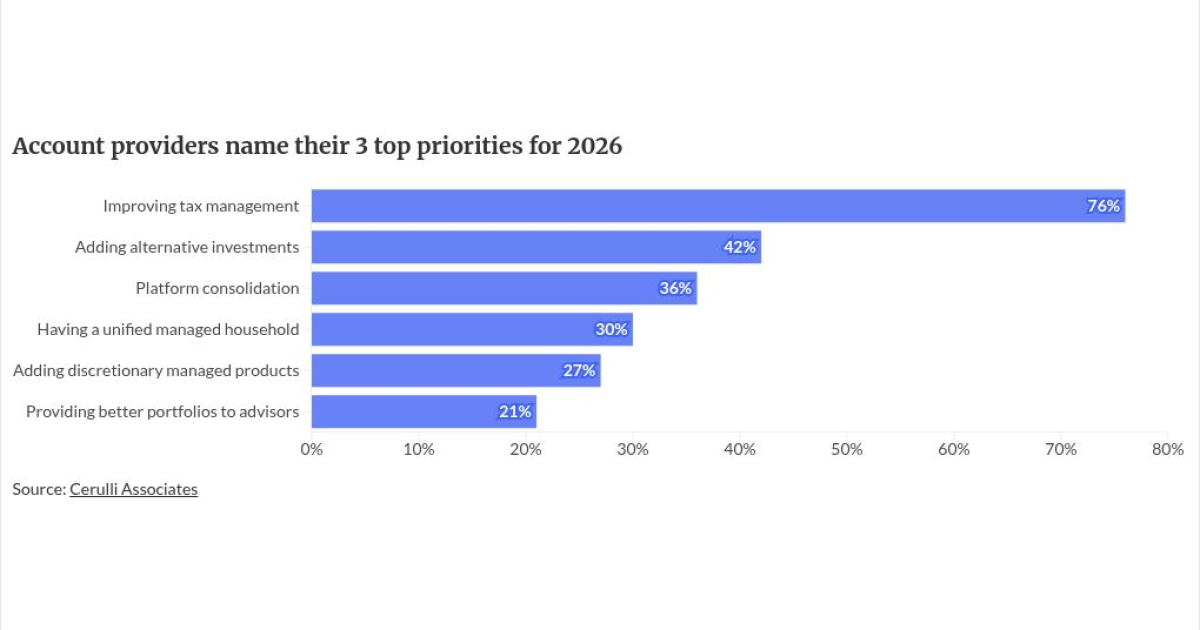
Managed account providers are putting tax services ahead of other priorities for 2025.
Cerulli Associates released a report last week showing just over three-quarters of firms that supply managed accounts to advisors now rank tax optimization as their top goal. In the research firm's industry survey, improving tax-management services ranked ahead of adding alternative assets or simplifying delivery methods.
Managed accounts differ from mutual funds. They are custom-built for individual clients. Many already include tax planning alongside access to stocks and bonds, as well as alternatives. The appeal of tax services is rooted in an immediate, measurable benefit, said Scott Smith, a senior director at Cerulli. Taxes are one of the heaviest drags on returns. They are also among the most avoidable, he said.
"While security selection is encumbered by the reality that 'past performance is no indicator of future returns,' tax optimization capabilities are a much more reliable source of post-tax alpha," Smith said in a statement.
Tax-loss harvesting has become the most common form of tax optimization. It works by selling depreciated stock to offset capital gains on winners. Scott Bishop, a partner and managing director at Presidio Wealth Partners in Houston, called tax-loss harvesting "only one lever in a much broader, multiyear planning process."
Bishop said long-term planning now stretches across retirement account moves, charitable giving, unwinding concentrated stock positions, business sales and employee stock plans. Outside firms can provide services to lower taxes in each scenario, he said. Advisors should remain the decision-makers because they understand "the client's complete financial picture." Presidio employs three certified public accountants and works regularly with clients' own CPAs and estate-planning attorneys.
"The next competitive frontier is not simply a more tax-efficient account. It is an advisory process that coordinates every account and major financial decision around a unified, multiyear tax plan," Bishop said.
Cerulli's survey found tax-loss harvesting is the service advisors have most often automated. Nearly 80% of respondents reported an automated system for harvesting losses. Only 43% said the same for moving clients out of concentrated positions, and 39% for reporting tax savings to investors.
Providers Add Tax Tools
Providers of separately managed accounts are aware of the demand. JPMorgan Chase, which carries an Alpha Score of 63 on AlphaScala's rating system, and Morgan Stanley, with a score of 60, are among the large financial firms expanding in this area. Others are turning to partnerships.
Envestnet, the financial technology company, is building on its long partnership with Vanguard. Vanguard's Advisor's Alpha program, which covers portfolio management and tax planning, is now available to Envestnet's wealth management division. Vanguard has also joined Envestnet's Fund Strategist Tax Management Advantage program. This lets advisors offer various tax services to clients free of charge. Erik Preus, Envestnet's group head of investment solutions, said participating asset managers agree to offset the portion of client fees that normally cover tax planning. Envestnet waives the rest.
"If the client is uncomfortable paying a fee for something that is going to be in their best interest, we wanted to work with the asset management community to mitigate that headwind and be able to offer this fund strategist tax management at no fee," Preus said.
Preus noted that tax-loss harvesting is one of the most popular services. With the stock market in a bull run exceeding three years, clients need ways to lock in gains without triggering huge tax bills. Many hesitate to follow an advisor's recommendation if it means owing $50,000 to the IRS, he said. The goal is to provide tax planning year-round rather than only in the spring.
"Advisors frequently just wait till the end of the calendar year. That is not always the best time to do it," Preus said. "Oftentimes, there's a year-end market rally, and so you're not capturing the losses from earlier."
AssetMark, the managed-portfolio provider and wealth manager, is also adding tax-optimization strategies through its unified managed accounts. The company said the additions will let more investors take advantage of tax planning. AssetMark announced Monday that assets overseen through its Tax Management Services offering jumped 130% over the past year to top $10 billion. The average rate of tax savings provided through the service rose from 1.29% in 2024 to 1.42% last year.
"No two clients have the same financial goals, tax considerations or investment preferences, and their portfolios should reflect those differences," David McNatt, chief wealth solutions officer at AssetMark, said in a statement.
Broader Push Into SMAs
Cerulli's report argues tax planning will become more essential. Advisors and asset managers are pushing more clients into separately managed accounts. Last year, just over $1 trillion flowed into SMAs, Cerulli said. The accounts are expected to grow from more than $16 trillion now to more than $20 trillion by 2027.
Smith of Cerulli said advisors who lack advanced tax planning risk losing business.
"Firms in this situation must assess their current situation and implement a platform development strategy immediately before advisors and clients begin to move their assets to providers that allow them to realize their maximum net assets post-tax," Smith said.