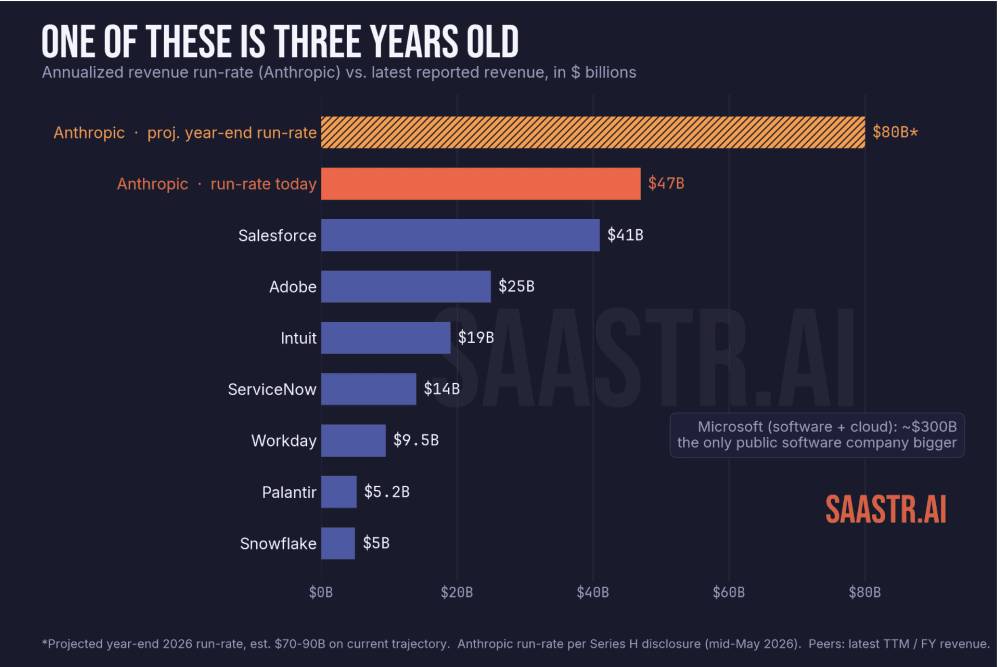
Anthropic exited 2025 at roughly $9 billion in run-rate revenue. By February 2026 it was $14 billion. Then $19 billion in March, $30 billion in April, $44 billion in early May, and $47 billion by mid-May, disclosed alongside its Series H. That is annualized run-rate, the most recent month times twelve, and Anthropic has been putting it in fundraise announcements where understating or inflating it would be securities fraud.
Hold that $47 billion up against the public software comps. Salesforce, the largest pure-play software company in the world, runs about $41 billion in revenue. Anthropic's run-rate passed it in April. Adobe is around $25 billion. Intuit about $19 billion. ServiceNow about $14 billion. Workday about $9.5 billion. Anthropic is already larger than every one of them, three years removed from its first dollar of revenue.
On its current trajectory the run-rate is tracking toward $70 to $90 billion by December. At that level there is exactly one public software company still ahead of it: Microsoft, whose software and cloud business runs around $300 billion.
That is the headline. Two companies look like exceptions on the surface. Oracle just reported $67.4 billion for fiscal 2026 and guided to $90 billion for fiscal 2027. Take it apart and it isn't. Oracle's actual software line was $24.5 billion, and it shrank 1% last year. The growth is $34 billion of cloud revenue, most of it renting GPUs to AI labs, plus services and hardware. Oracle is now an AI-datacenter landlord with a database attached. IBM is the same shape: a roughly $60 billion company that is mostly consulting and infrastructure, with a software segment around $30 billion. On a software-versus-software basis, both sit below Anthropic.
Take the ten next-generation software names investors watch: Palantir, Snowflake, CrowdStrike, Datadog, Zscaler, Okta, HubSpot, MongoDB, Cloudflare, and Confluent. Their combined revenue is roughly $33 billion. Anthropic's run-rate today is bigger than all ten of them put together. Palantir, at $5.2 billion in trailing revenue, and Snowflake, at $5.0 billion, are the two largest on that list, and Anthropic has been adding more than a full Palantir to its run-rate in a matter of weeks.
Two caveats keep the analysis defensible. First, run-rate is not annual revenue. The $47 billion is one strong month annualized. The public comps above are trailing-twelve-month actuals. On actual calendar-2026 revenue, Anthropic will land somewhere around $20 to $26 billion for the year, which puts it in the top five of software, not at number two. The year-end run-rate tells you where the line is heading. The trailing revenue is where it has been. Second, Anthropic books a meaningful share of revenue gross. Sales through AWS, Google, and Microsoft are counted as full end-customer spend, with the partner's cut booked as a cost. That inflates the top line relative to a net-reporting B2B company. It does not change the trajectory.
Neither caveat dents the core finding. Anthropic did not get here selling seats. It got here selling tokens. A single developer running an agent against a real codebase consumes at a rate no per-seat plan ever modeled. Claude Code alone went from zero to $2.5 billion in run-rate in about nine months, larger than most of the companies on that chart, built by one product team and priced entirely by consumption.
The public software names sitting below Anthropic are, with few exceptions, seat-based businesses. The market has already started repricing them, with the public software multiple at decade-plus lows. The revenue gap is the tell. When the fastest-scaling software company in history monetizes work instead of logins, every roadmap built on counting users is now competing with a model that gets paid for output.
Claude Code alone went from zero to $2.5 billion in run-rate in about nine months, larger than most of the companies on that chart.