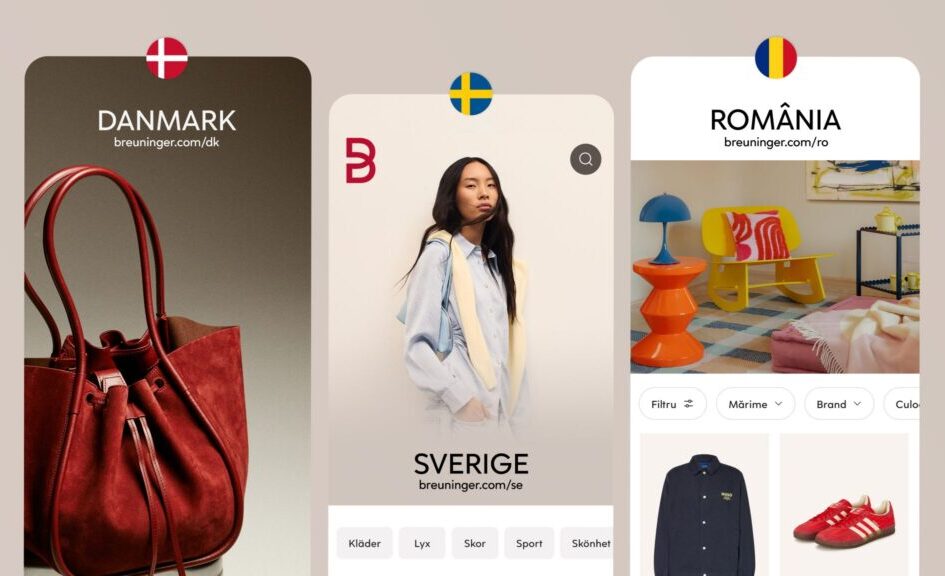
Breuninger has opened its online store in Denmark, Sweden, and Romania, bringing the German premium retailer’s European footprint to 13 markets. The expansion ends a four-year pause in geographic additions and signals that the company sees enough ecommerce momentum in the Nordic and Eastern European regions to justify the operational lift.
The launch is Breuninger’s first multi-country push since it added the Czech Republic in 2020. Before that, it entered Poland in 2018 and then a block of five markets – Netherlands, Belgium, Luxembourg, Spain, and Italy – in summer 2022.
Breuninger’s Three-Country Launch: The Catalyst
CEO Holger Blecker described the three new markets as “highly attractive” and noted their “strong affinity for premium and luxury fashion” combined with “dynamic ecommerce growth.” The retailer will serve consumers in local languages and has partnered with PostNord and DHL for delivery in Denmark, Sweden, and Romania respectively.
The simple read: three new countries equals three new addressable markets. The better read is that Breuninger is timing its entry into regions where ecommerce growth rates already justify the fixed cost of localization and logistics. The company is not spraying into untested territory. It is targeting markets that already show premium consumption patterns.
Mapping the Expansion Path: From DACH to 13 Markets
Breuninger started its online store in 2008, long before most European department stores had meaningful direct-to-consumer operations. The first cross-border step was Austria, followed two years later by Switzerland, completing the DACH region (Germany, Austria, Switzerland). Poland came next, then the five-country wave in 2022, and quickly after that the Czech Republic.
Current expansion follows a pattern:
- Year 1–2 after a new market launch: localized site, local language, local payment methods.
- Year 3–4: marketplace model rollout, bringing third-party brands onto the platform.
- Year 5+: potential physical pop-ups or partnerships if demand justifies fixed retail space.
Breuninger introduced its marketplace model in Germany several years ago and rolled it out to Austria and the Netherlands earlier this year. The company has not confirmed a timeline for marketplace in the three new countries. The pattern suggests it will follow the same playbook.
Why Romania and Sweden Stand Out
Not all three new markets are equal in growth profile. The source data points to two clear outliers:
The Romanian statistic is striking. A decade of compounding new online shoppers means the addressable base is still expanding rapidly, even if the absolute level remains below Western European averages. Swedish ecommerce’s double-digit rebound after a post-pandemic slowdown suggests the market is re-accelerating. Denmark offers a mature premium consumer base that fits Breuninger’s curated assortment.
The Risk to Watch: Logistics Execution
The critical execution risk is whether the retailer can match the logistics speed and returns convenience that local competitors and global players such as Zalando already offer in these markets. Partnering with PostNord and DHL gives Breuninger last-mile capability. Delivery speed and reverse logistics will determine repeat purchase rates.
The Marketplace Model as a Growth Multiplier
Breuninger’s core online business is owned inventory plus curated third-party brands through its marketplace. The company has been developing the marketplace model for years in Germany and is now extending it to Austria and the Netherlands.
Key insight: The marketplace model improves gross margin because inventory risk shifts to partner brands. It also widens assortment without requiring proportional warehouse space. Rolling out the marketplace in Denmark, Sweden, and Romania would allow Breuninger to scale revenue without commensurate working capital commitments.
Practical rule for assessing the expansion’s quality: watch for announcements of marketplace onboarding in the new markets within 12–18 months of the launch. If that happens, the expansion thesis is confirmed. If Breuninger relies only on owned inventory, revenue growth will be slower and margin pressure higher.
The CEO Signals More to Come
Blecker called the expansion “an exciting foundation for what is ahead.” This implies further moves are already in planning. The company’s pace – roughly one new country per year on average – suggests the next announcement could come in late 2025 or early 2026.
Confirmation Signals and Invalidation Risks
Confirmation signals:
- Local-language sites generate consistent traffic from organic search within six months.
- Marketplace launches in at least one of the three new countries by mid-2026.
- Blecker or the company announces further European expansion within 12 months (e.g., Norway, Finland, or Central Europe).
Invalidation signals:
- Delivery complaints or returns friction that damages the premium positioning.
- Slower-than-expected revenue growth from Romania, where the shopper base is still developing and average order values may be lower than in Sweden or Denmark.
- Macroeconomic headwinds, especially in Sweden, where a weak krona and consumer uncertainty have weighed on discretionary spending.
Breuninger remains a family-owned business with no public equity, so traders cannot buy the stock directly. The expansion offers a read-through for European ecommerce logistics providers, premium retail landlords, and competitors such as Zalando or About You. If Breuninger’s bet on Romania and Sweden pays off, it validates the thesis that premium direct-to-consumer can still grow in a market dominated by marketplaces.
For a broader view on how retail expansion patterns affect the stock market analysis landscape, the same principles of catalyst timing, confirmation signals, and execution risk apply across sectors.