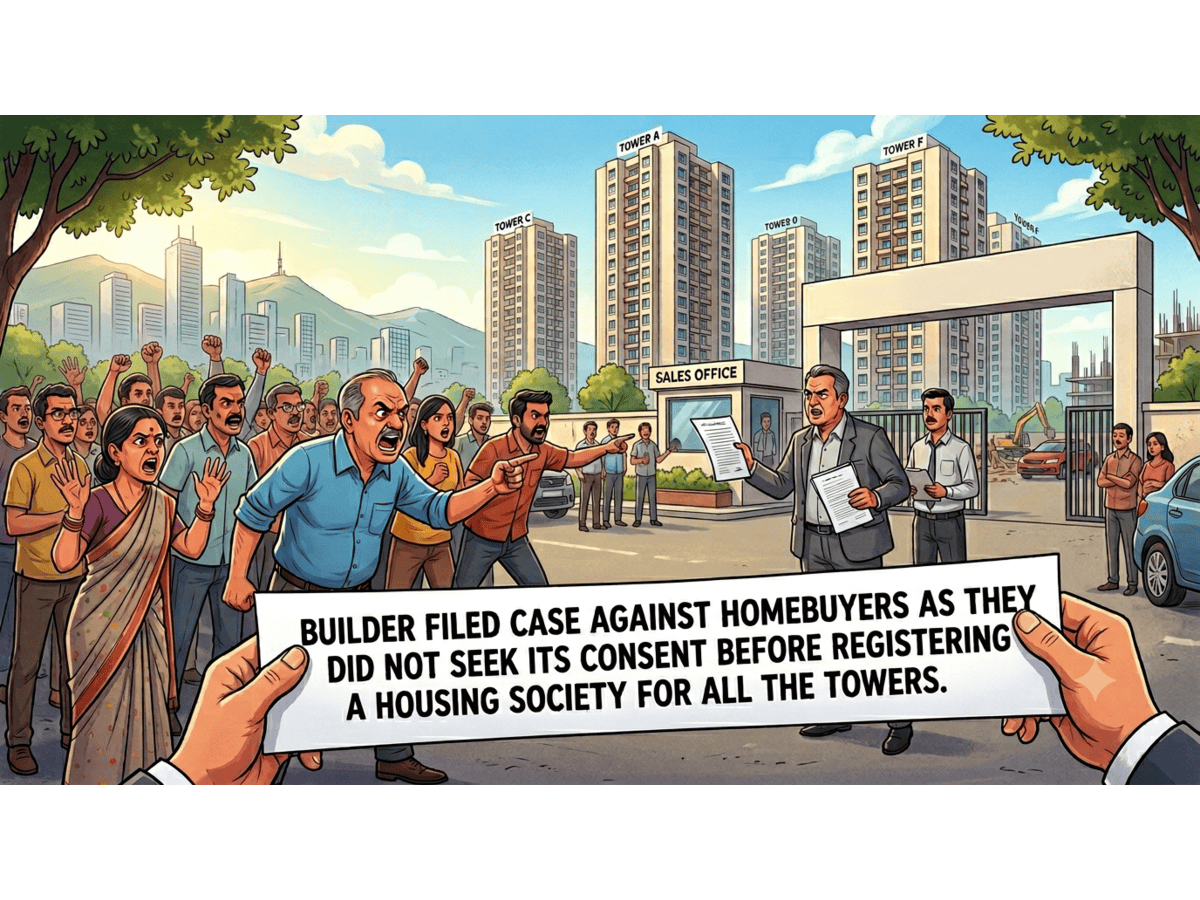
The Bombay High Court ruled that homebuyers in a multi-tower project can register a single housing society without the builder's consent, rejecting a developer's challenge that sought to block the move.
The dispute started when residents of a housing project in the Mumbai metropolitan region formed a society covering all towers after the builder delayed the process for nine years. The builder filed a suit arguing the homebuyers needed its approval before registering the society, and that each tower should have its own society rather than a single entity for the entire project.
The court disagreed. A single-judge bench held that the Maharashtra Ownership of Flats Act (MOFA) and the state's cooperative societies law do not require a developer's consent for society formation. The ruling cited Section 10 of MOFA, which obligates the builder to facilitate society formation within the prescribed period. When the developer fails to do so, the court said, the homebuyers' right to form a society is not contingent on the builder's approval.
The bench also rejected the argument that each tower needed a separate society. The court noted that the project had common amenities, shared infrastructure, and a single layout approval, making a single society the practical and legally sound structure. The ruling said the builder's insistence on tower-wise societies appeared aimed at retaining control over common areas and maintenance funds.
The order follows a pattern of Indian courts pushing back against developer tactics that delay society formation. In several previous cases, courts have fined builders for failing to transfer common areas or for withholding documents needed for registration. The Bombay HC's decision reinforces that the statutory obligation to form a society rests with the builder, and the remedy for delay lies with the homebuyers, not the developer's consent.
The builder had also argued that the homebuyers acted without its consent before registering the society. The court dismissed this, stating that the law does not make the developer a gatekeeper for society formation. The ruling said the builder's remedy, if it believed the society was improperly formed, was to approach the cooperative registrar, not to file a civil suit blocking the registration.
For homebuyers in stalled or delayed projects, the judgment provides a clear path. If the builder has not formed a society within the statutory period, residents can proceed on their own. The ruling covers multi-tower projects where common facilities are shared, removing the ambiguity that developers have used to fragment resident representation.
The court did not award costs against the builder but directed it to cooperate with the society registration process. The builder has the option to appeal.
A copy of the order is available on the Bombay High Court's website.