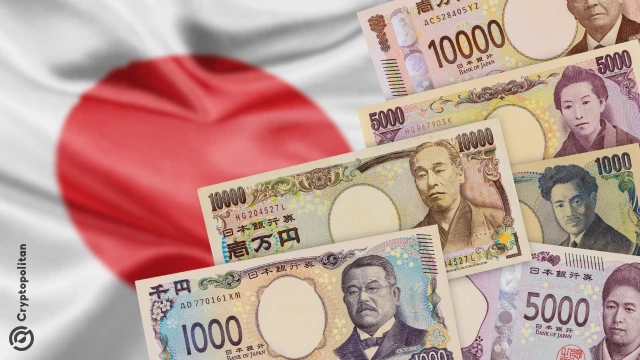
The Bank of Japan's two-day policy meeting ending June 16 is expected to deliver a rate hike to 1%, a level last seen in 1995. Swaps markets price a 93% probability of the 25-basis-point increase from 0.75%. A Reuters poll of 70 economists found 66 expect the move by the end of June.
The decision marks another step in Japan's monetary-policy shift away from a decade of near-zero rates. For crypto markets, the question is how much activity on yen-denominated exchanges shrinks as yen borrowing costs rise.
BTC/JPY remains one of the world's most active fiat-crypto trading pairs. That means the BOJ's rate path shapes local exchange volumes more directly than in most developed markets. A recent review of Japan's crypto exchanges showed bitFlyer handles about 38% of all domestic crypto transactions. That concentration gives any change in yen liquidity an outsized effect on a handful of platforms.
The mechanical effect is straightforward. Japan's zero-rate policy made yen borrowing cheap, supporting both global carry trades and local leveraged crypto positions. A rise to 1% raises the funding cost for those positions directly. For a trader running yen-denominated leverage, the difference between 0.75% and 1.00% is a roughly 33% increase in the cost of carry.
The Political Bottleneck on Further Hikes
The more consequential read is not the June decision itself but the forward guidance around it. Two hawkish BOJ board members see their terms expire in July 2027. Prime Minister Sanae Takaichi, a proponent of loose fiscal and monetary policy, will appoint their replacements. "Next year's personnel shift could overhaul the balance within the board," Tsuyoshi Ueno, senior economist at NLI Research Institute, told Reuters. "The BOJ may find it difficult to do anything that could draw the government's ire."
That political constraint sits alongside uncertainty at the top of the bank. Governor Kazuo Ueda, 74, was hospitalized June 10 for treatment of an infected liver cyst and will miss the meeting. Deputy Governor Ryozo Himino will chair in his place. Deputy Governor Shinichi Uchida, recently diagnosed with leukemia, will conduct the post-meeting press conference. Mari Iwashita, executive rates strategist at Nomura Securities, told Reuters the BOJ may avoid clear signals on the future path given the health situation. "It's also becoming more unclear on whether the BOJ would hike again this year," she said.
What a Hawkish vs. a Dovish Statement Means
The yen has weakened past 160 per dollar, a level that triggered an estimated 11.7 trillion yen ($73 billion) in currency intervention since late April, Reuters reported. Shigeto Nagai, head of Japan economics at Oxford Economics, told Reuters the coming hike is a defensive move. "I interpret the coming rate hike as a defensive measure intended to prevent further yen depreciation," he said.
More than 75% of economists polled by Reuters expect another hike to 1.25% in the fourth quarter of 2026. Two-thirds forecast the rate reaching 1.5% by mid-2027. If the BOJ delivers those hawkish signals, traders expect a stronger yen and higher yen funding costs. A dovish tone – emphasizing the lack of a clear path – would leave cheap yen alive for another quarter, at least for carry trades with longer tenors.
The Crypto-Specific Risk
Japan continues to be one of the largest regulated crypto markets globally. The risk for crypto volumes is not the June hike itself but the cumulative effect of a full cycle. A move to 1.5% would represent the first truly restrictive policy in Japan in decades. The cost of funds for leveraged positions would rise meaningfully. Retail leverage trading on yen-denominated pairs would compress.
The counterargument: Japan's crypto market is heavily regulated and institutional, not purely speculative. bitFlyer and other licensed exchanges serve corporate and long-term holders alongside retail traders. Those participants may be less sensitive to rate changes than short-term levered players. The two scenarios are not mutually exclusive – volumes could shift from leveraged retail toward spot and institutional flows.
The next data point is June 16, when the BOJ releases its statement and Uchida holds the press conference. Traders will watch for any hint about the pace of hikes in the second half of 2026. The political appointments in 2027 remain the longer-term wildcard.
For broader context on bitcoin's sensitivity to macro shifts, see AlphaScala's crypto market analysis.