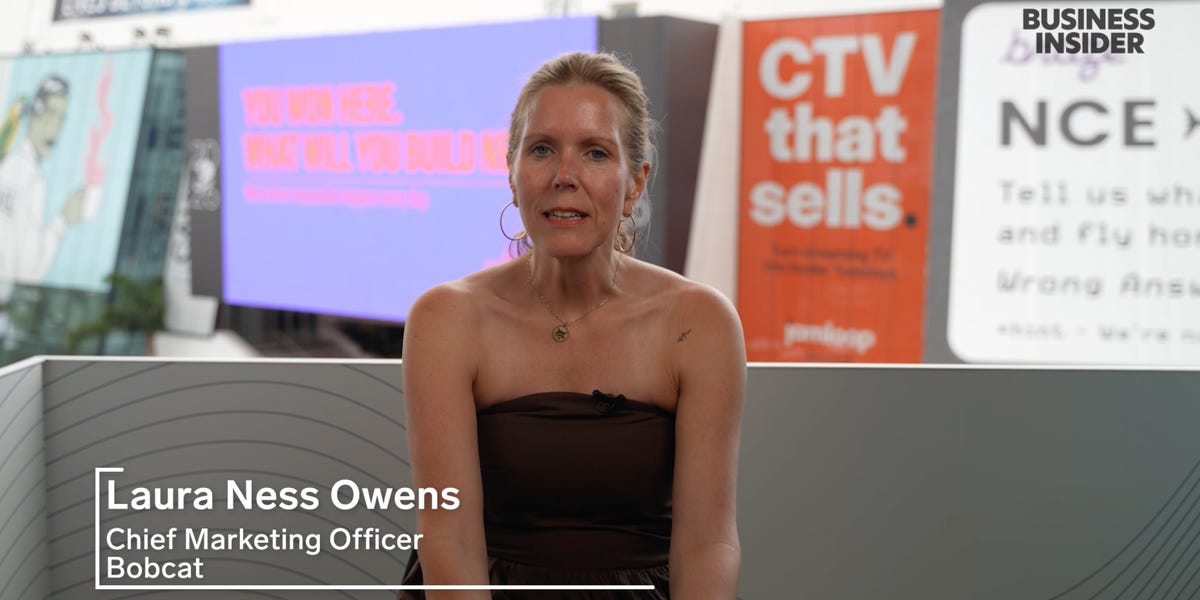
Laura Ness Owens, chief marketing officer at Bobcat, makes a simple point about how customers now buy compact loaders and excavators. They skip the search bar. They skip the company website. They open ChatGPT or a similar model and ask for a recommendation in plain language.
"Today, many customers are going right to the large-language-models and saying, 'I want the right loader for me, to do this type of work'," Owens said. "So they are skipping much of that research stage that we were able to guide."
The implication is straightforward for any brand that relies on search-driven demand generation. The old funnel – search, website visit, form fill – no longer describes the path for a growing share of buyers. An LLM ingests product reviews, earned media, dealer reviews, and forum discussions. It synthesizes them into a single answer. If a company does not control what appears in that synthesis, the LLM can surface criticism as easily as praise.
"You have to understand that the good, the bad, and the ugly are out there," Owens said. The comment reflects a shift in emphasis at Bobcat. Instead of optimizing landing pages for a narrow set of keywords, the company now focuses on the broader customer experience – the service center visit, the delivery process, the dealer interaction – because those become the signals that LLMs rank.
"It's pushed us to really focus greater on that customer experience," she said.
The naive read: This is just another "content is king" message from a marketing executive. The better read is that the mechanism of discovery has changed in a way that penalizes brands that treat marketing as a separate function from operations. An LLM does not distinguish between a press release and a Reddit thread. It weights all public text by relevance and recency. A dealer who posts a video walkaround of a machine may have more influence on the model's output than the manufacturer's own product page.
Owens did not offer a playbook for gaming the new system. She described something harder: a shift from controlling the message to earning it. The same logic applies across industries where the purchase decision involves comparison shopping – construction equipment, home improvement, business software. If the customer asks an LLM, the brand's job is to make sure the data the model scrapes reflects actual product quality, not marketing claims.
For a trader or investor watching Doosan Bobcat, the parent company, the CMO's remarks offer a warning about measurement. Traditional marketing ROI models based on click-through rates and conversion funnels lose relevance when the conversion happens inside a black-box model. Companies that cannot adapt their metrics will misallocate spend. The first concrete sign of trouble would be a decline in dealer feedback or a rise in negative reviews that the LLM surfaces.
Owens' point about the "good, bad, and ugly" suggests Bobcat is already monitoring what LLMs say. For any company whose customers use generative AI for research, the next step is the same: audit the model's output, fix the underlying experience, and stop assuming the old search-based path still works.