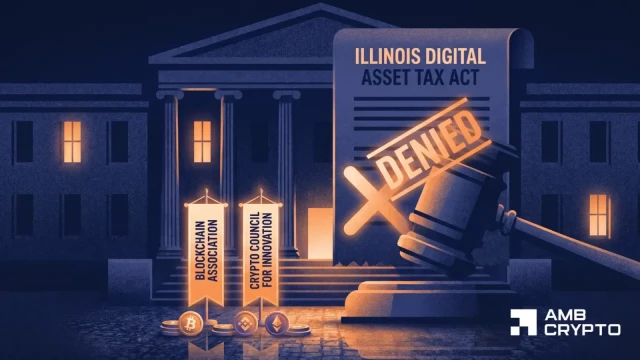
The Blockchain Association and the Crypto Council for Innovation (CCI) filed a lawsuit Thursday challenging Illinois' new Digital Asset Tax Act, arguing the state overstepped its constitutional authority by singling out digital-asset activity for a special tax.
The suit asks a federal court to declare the law unlawful and block enforcement through preliminary and permanent injunctions. The groups claim the act violates the Dormant Commerce Clause, a legal principle from the U.S. Constitution's Commerce Clause that stops states from creating tax or regulatory systems that discriminate against interstate commerce or burden it unfairly.
"A tax on digital asset activity with no equivalent tax for traditional assets unlawfully picks winners and losers through the tax code," CCI CEO Ji Hun Kim said.
The concern is that if Illinois can create a special tax on digital-asset activity, other states might follow with their own rules and taxes. That would leave a company operating across the U.S. dealing with a different digital-asset tax structure in every state.
The lawsuit also alleges the Illinois law violates the federal Internet Tax Freedom Act (ITFA), which restricts certain discriminatory taxes on internet access and forms of electronic commerce.
"We are bringing this challenge to protect those fundamental principles and ensure Illinois stays within the bounds of the law," Blockchain Association CEO Summer Mersinger said.
Beyond the tax itself, the crypto groups are challenging how it was passed. They argue the Digital Asset Tax Act moved through the Illinois legislature within hours, without enough debate, public notice, or opportunity for affected businesses and residents to provide input. The groups also claim the law raises due process concerns because its requirements may be unclear. If the rules are vague, businesses and users cannot know when the tax applies or how much they owe, they said.
"States have an important role to play in fostering innovation, but that authority has constitutional limits," the suit argues.
The lawsuit comes as the Blockchain Association has separately supported the recent U.S. SEC proposal to revise Regulation NMS, specifically Rules 611 and 610(e).