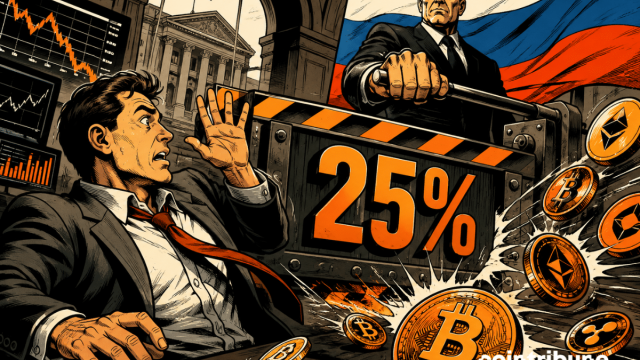
The Bank of Russia wants to cap the role of crypto in how brokers measure their financial strength. A draft regulation published August 14 sets a 25% threshold for digital assets that can be counted in the calculation of a firm's equity.
The limit applies to brokers, securities managers, forex dealers, and operators of crypto exchange platforms. Not every token qualifies. Assets must be admitted for trading on a Russian organized market and held in the accounts of a recognized crypto custodian, the central bank said.
The 25% cap does not bar a broker from holding more crypto in absolute terms. It restricts the share of crypto in the prudential calculation that determines the firm's capital adequacy. A broker with 1 billion rubles in total eligible assets could use up to 250 million rubles worth of qualifying crypto in its equity.
That nuance matters. The regulator wants to make sure intermediaries keep enough conventional capital to absorb losses. Crypto holdings will now feed into market risk and credit risk calculations, so a strong exposure directly hits the ratios used to measure a broker's solvency.
Moscow has been laying the groundwork for months. At the end of July, the Bank of Russia published rules allowing brokers to use certain crypto assets as collateral for margin operations. The new equity draft extends that framework. On August 1, President Putin signed a comprehensive law regulating cryptocurrency transactions. That text takes effect September 1, 2026.
Under that law, non-qualified individuals can buy crypto after passing a test, with an annual cap of 300,000 rubles (about $3,800) per intermediary. Qualified investors face no such cap. For brokers, the message is different: they can hold and trade crypto, integrate it into their accounts, but the 25% barrier stands.
Russia's stance on digital assets has shifted sharply in recent months. Crypto transactions are becoming legal inside a regulated perimeter. New exchanges and custodians can apply for licenses. Traditional brokers get a formal place in the system.
Daily crypto payments remain prohibited inside Russia – the ruble keeps its monopoly for buying goods and services. But companies active in foreign trade have more room to use digital assets for settlements, especially since Western sanctions have added friction to traditional banking channels. Crypto gives exporters and importers an alternative infrastructure.
Moscow is not letting the market run free. Operators need licenses, custodians, and capital rules. Russia already placed exchanges, brokers, and other intermediaries under central bank supervision. The 25% cap adds another layer: Russian brokers can hold crypto in their accounts, but not enough to make it the foundation of their financial strength.