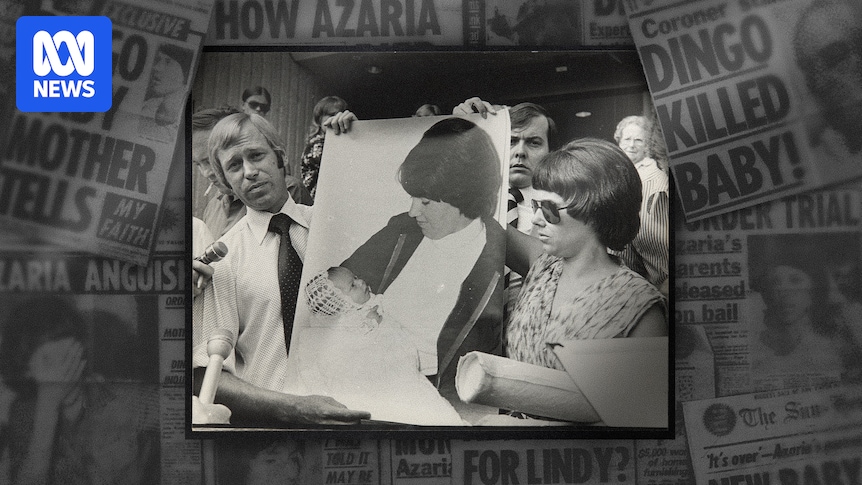
A baby's jacket found in the outback overturned Lindy Chamberlain's murder conviction. Now the ABC views the artefacts at the National Museum of Australia, including the tea towels and prison cell door number.
A baby girl's jacket turned up in the outback by chance four decades ago. It unraveled Lindy Chamberlain's murder conviction. Now the ABC has been given special access to that evidence and the broader collection of artefacts from the case, preserved at the National Museum of Australia.
A tea towel stands out in the collection. Emblazoned on linen are two dingoes atop a rocky outcrop, scouting a Central Australian landscape. A stamp in the corner reads: "Azaria Chamberlain trial, Darwin Australia, 1982."
The tea towel was sold during one of Australia's most infamous murder trials, where Lindy Chamberlain was sentenced to life in prison for killing her nine-week-old daughter Azaria. She was eventually exonerated. A court found the baby had been taken by a dingo from a campground at the foot of Uluru during a family road trip in August 1980.
Senior curator Sophie Jensen has spent 30 years capturing the case through a library of objects. She says T-shirts were also sold throughout the trial. "[It's] so difficult to imagine now, that kind of thing could occur," Jensen said.
Veteran journalist Tony Eastley, who covered the case for the ABC, remembers how locals queued up early to secure a seat in the public gallery. "There was memorabilia left, right and centre," he said. "The notoriety of the case was worldwide. People were running gambling books on the likely outcome."
Decades on, the phrase "dingo's got my baby" has become entrenched in Australian pop culture, referenced in television shows, satirized in international comedy, and immortalized in films like A Cry in the Dark. "It was a huge moment to have Meryl Streep coming to play Lindy, which remains an iconic moment in Australia's cinema history," Jensen said.
More than 600 items related to the case sit in storage at the NMA, some deemed too sensitive to exhibit. To mark 40 years since Chamberlain was released from prison, the ABC was granted special permission to view part of the collection, including the clothes infant Azaria was wearing when she died and the number from Chamberlain's prison cell door in Darwin. There is also a lock of hair from the baby she gave birth to just weeks after the guilty verdict, Kahlia, who was removed from Chamberlain's care while she was incarcerated.
"We have items that come from the campsite itself; we have mattresses, sleeping bags, the children's parkers, the bottle warmers, torches used to search on that dreadful evening," Jensen said. "[It] is almost a complete archive of the material culture around this particular episode in the Chamberlain family's life."
Following Azaria's disappearance, Chamberlain was instantly in the public eye and became a polarizing figure. "She was quite a startling kind of black-haired, good-looking woman who was quite diminutive had a presence about her," Eastley recalled. "She was the most recognised woman in Australia at the time."
The handmade outfits Chamberlain wore sparked so much public opinion they are preserved as part of the collection. "She would appear walking into the courtroom and people would comment on her dresses, just as they would comment on Princess Diana's dresses," Eastley said.
From the museum's storage, Jensen unpacked one strappy black dress that offended more than most. It was part of a matching black-and-red mother-infant set Chamberlain designed to wear with her son before handing it down to her daughter. "It became such a central piece," Jensen explained. "People were horrified at the idea a mother would dress their baby in black. It did become another kind of way in which the Australian public judged Lindy to be an unnatural mother."
The Chamberlain family was subjected to an unprecedented level of "malicious gossip," according to Coroner Denis Barritt, who handed down his findings into Azaria's death at the first inquest in February 1981. The level of superstition was so intense his official findings included a line stating the name Azaria did not mean "sacrifice in the wilderness." Barritt took the unusual measure of televising his findings in an attempt to stem the public hysteria. He criticized the police investigation for failing to show impartiality and took aim at the Northern Territory government, claiming it had set "hidden traps for decent people" in letting tourists camp alongside dangerous animals without adequate warnings.
"The death of this babe in an area where previous attacks causing bodily injury, or potential bodily injury, is too high a price, and a totally unnecessary price to pay," Barritt said.
The findings sparked outrage. By November 1981, the NT Supreme Court quashed them. A second inquest in December that year recommended Chamberlain be charged with murder and her husband Michael with accessory after the fact. Both parents were charged and faced a grueling six-week trial.
Court sketches held by the NMA show the key moments: a park ranger giving evidence on the dangers of dingoes, Chamberlain taking the stand to defend his wife, and Lindy Chamberlain with her chin raised and eyes set to the ground as a jury found her guilty. The defense relied on Chamberlain's account that a dingo had taken her baby. Jurors weren't convinced. Azaria's body was never recovered. The jumpsuit she was wearing at the time of her death didn't have dingo saliva on it. Chamberlain argued the animal's DNA would have been contained to the matinee jacket her child had been wearing. The jacket had not been found. The prosecution questioned its existence.
A freak accident in January 1986 unraveled the conviction, along with the revelation that some evidence used to convict Chamberlain was shoddy. A British tourist fell from Uluru during a climb. In the search for his remains, Azaria's matinee jacket was discovered in sand dunes near a dingo lair. "Everything hinges on this one moment," Jensen explained. "That the right person was somehow in the right place at the right time to find that matinee jacket is just an incredible moment of chance that changed the whole course of the case."
That discovery came alongside growing discontent from scientists that the forensic tests showing blood inside the Chamberlains's family car – a yellow Holden Torana – were flawed. "Samples taken from the car [were] supposed to be foetal haemoglobin and ended up being sound-deadening spray that was put on the Torana when it was made," Eastley said.
Like the matinee jacket, the car has since transitioned from evidence to artefact at the NMA. Jensen said Michael Chamberlain, who died in 2017, rebuilt the hatchback after police returned it to him in boxes. When he handed it over to the museum, he said the car was a testament to complete forensic failure and the triumph of justice.
Chamberlain was released from prison on February 7, 1986. Years later, Coroner Elizabeth Morris determined Azaria Chamberlain had been killed by a dingo. Eastley flew back to the Northern Territory to cover the fourth and final coronial inquest in 2012. "It was a breakthrough for everyone involved and I must say I was quite moved," Eastley said. He said while the ABC wasn't part of that poor treatment, it was important to acknowledge the "extraordinary tale of woe and torment for the family."
The coroner determined it was "obvious, not just from these findings, from other injuries and deaths since, dingoes can and do cause harm to humans." Azaria's death certificate was officially updated to reflect the fatal attack. The Chamberlain family has never received an apology from the NT government.
While individual items in the Chamberlain collection are sometimes brought out for display, the vast and raw nature of the artefacts has made dedicated exhibitions difficult. "We work really closely with Lindy as to when and how she is comfortable with those items coming out and being viewed," Jensen said. The first exhibit the NMA held in 1994 drew a "dreadful" response from audiences. "It was felt to be 'in bad taste' … 'ghoulish', and people still were very divided," Jensen said.
The collection does not go unnoticed. "Lindy regularly interacts with the collection," Jensen said. "She speaks to it very directly, she brings her story to it during lectures, during debates, for access for different particular groups who have interests in the material." Parts of the collection are also used for training by professionals like members of the Australian Federal Police and are accessible to the public online.
Jensen said she hopes the archive "will serve to really help Australians remember, rather than try and forget, what was a pretty ugly episode in Australia's legal history." "[We share] the lessons that were learned, the dangers that we can observe, because history will and can repeat itself," she said. "One day, I do hope that it'll be the right time to bring much more of the collection out for people to actually enjoy as an exhibition."
Prepared with AlphaScala research tooling and grounded in primary market data: live prices, fundamentals, SEC filings, hedge-fund holdings, and insider activity. Each story is checked against AlphaScala publishing rules before release. Educational coverage, not personalized advice.