Commodities● Neutral
Arizona Eagle Mining Extends High-Grade Gold at McCabe Project
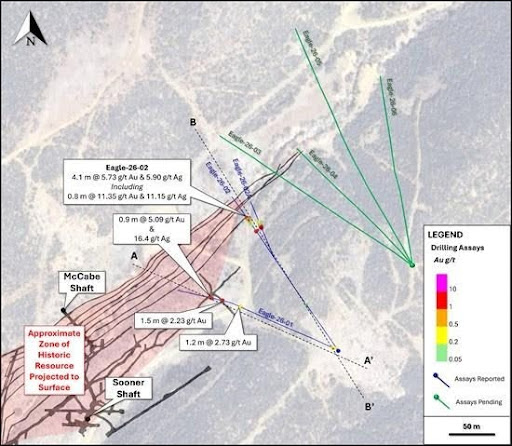
Arizona Eagle Mining (TSXV: AZEM) confirmed high-grade gold mineralization extending 50 meters beyond its 880,000-ounce historic resource at the McCabe mine.
Continue with
Arizona Eagle Mining (TSXV: AZEM) has reported initial results from the first three holes of its Phase 1 drill program at the Eagle Project in Yavapai County, Arizona. The company, which is currently trading at $1.40, is focused on the McCabe Mine, a historic gold-silver deposit. The primary objective of this exploration phase is to identify extensions of the mineralized system beyond the existing historic resource estimate of approximately 880,000 ounces of gold at a grade of 11.7 g/t. By targeting northeasterly-striking, sulfide-bearing quartz veins, the company aims to prove that the deposit is not confined to the boundaries defined by previous mining activities.
Mechanism of the Mineralized Extension
The core of the current exploration thesis rests on the structural continuity of the McCabe district. The initial drill results have successfully confirmed high-grade mineralization extending approximately 50 meters beyond the 750-meter strike length previously associated with the historic resource. This is a critical development for the project because it suggests that the geological system remains open for further expansion. The company is specifically testing the hypothesis that the mineralization continues past an interpreted fault offset where historical underground exploration had previously ceased. If the mineralization is indeed continuous across this structural boundary, the potential for increasing the total resource size becomes significantly more tangible than a simple re-evaluation of known zones.
Structural Corridor and Future Drilling
Beyond the initial three holes, the company has completed drilling for holes 3 through 6, which are aimed at testing the northeast extension toward the Eagle Silver Project. This secondary project is located roughly one kilometer along the same structural corridor. The proximity of these two assets suggests a district-scale potential that the company is actively attempting to validate. Hole 7 is currently testing the southwest strike of the McCabe zone, approximately 400 meters from the historic resource center. The pending assays for these holes will serve as the next primary catalyst for the stock, as they will determine whether the structural corridor is as continuous as the initial Phase 1 results imply.