Crypto▼ Bearish
Argentine Police Seize $8M USDT in 90-Raid Operation
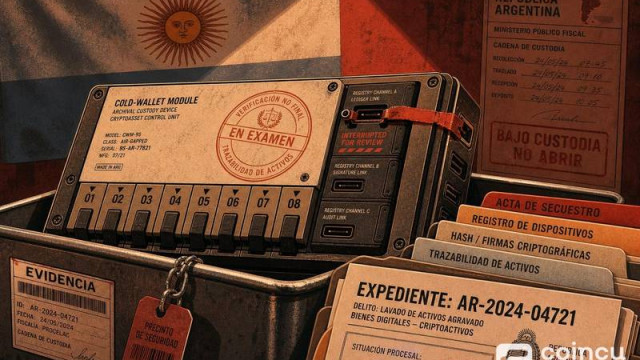
Argentine authorities arrested 24 people and seized over 8 million USDT in Operation Fake Coins. The case exposes how Binance P2P and WhatsApp enabled cross-border fraud.
Continue with
Argentine authorities arrested 24 people and seized more than 8,000,000 USDT (roughly $8 million) in a single coordinated enforcement action. The Buenos Aires prosecutors’ office executed 90 simultaneous raids across multiple jurisdictions under Operation “Fake Coins,” one of the largest crypto-related police actions in the country’s history.
The scale of the seizure – which also includes nearly ARS 60,000,000 in cash, 80 mobile phones, and multiple computers and tablets – surpasses the amount confiscated in the 2024 RainbowEx case, according to prosecutors. That claim has not been independently verified. More important than the headline number is what the operation reveals about how stablecoin fraud works, where the regulatory gaps are, and what it means for exchanges operating in Latin America.
The Fraud Mechanism: WhatsApp Social Engineering and Binance P2P
Investigators identified a fraud network that relied on social engineering through WhatsApp to recruit victims. More than 100 WhatsApp and WhatsApp Business activation codes were tied to the network, indicating systematic use of disposable phone numbers to contact potential targets.
Once victims were convinced to invest or transfer funds, the scheme converted their money into USDT through Binance’s peer-to-peer marketplace. The stablecoins were then transferred to Venezuela using Binance Pay. This chain – social engineering via messaging app, P2P on-ramp, stablecoin cross-border transfer – mirrors patterns seen in crypto-linked criminal operations across Latin America and Southeast Asia.
A Separate Branch in Azul
A related part of the case in the city of Azul yielded an additional seizure of 4,025 USDT from accounts located abroad. That detail confirms the network operated across multiple Argentine jurisdictions and maintained foreign accounts, likely to complicate recovery.
Regulatory Gap: PSAV Registry vs. Unregistered Operators
Argentina’s Comision Nacional de Valores (CNV) maintains a Registry of Virtual Asset Service Providers (PSAV). As of May 26, 2025, all registration and cancellation requests must be submitted through the Tramites a Distancia platform under Resolution General No. 1058.
The gap between this formal regime and reality is central to the case. Both the prosecutor notice and media reports describe victims who relied on supposed financial advisers operating outside the registration framework. The PSAV registry exists specifically to let users verify whether a provider is authorized. Retail investors in practice often do not check.
Why USDT Is the Default Instrument for Cross-Border Fraud
The USDT-specific nature of the seized assets is not coincidental. Unlike volatile tokens, USDT maintains a near-constant dollar peg, trading at $0.998 with a market capitalization exceeding $188 billion. That stability makes it attractive for actors seeking to move value across borders without exchange rate risk.
Stablecoins are now the default instrument in cross-border fraud schemes because they clear instantly on the blockchain, are widely accepted by centralized exchange on-ramps, and evade the slower monitoring of traditional bank wire systems.