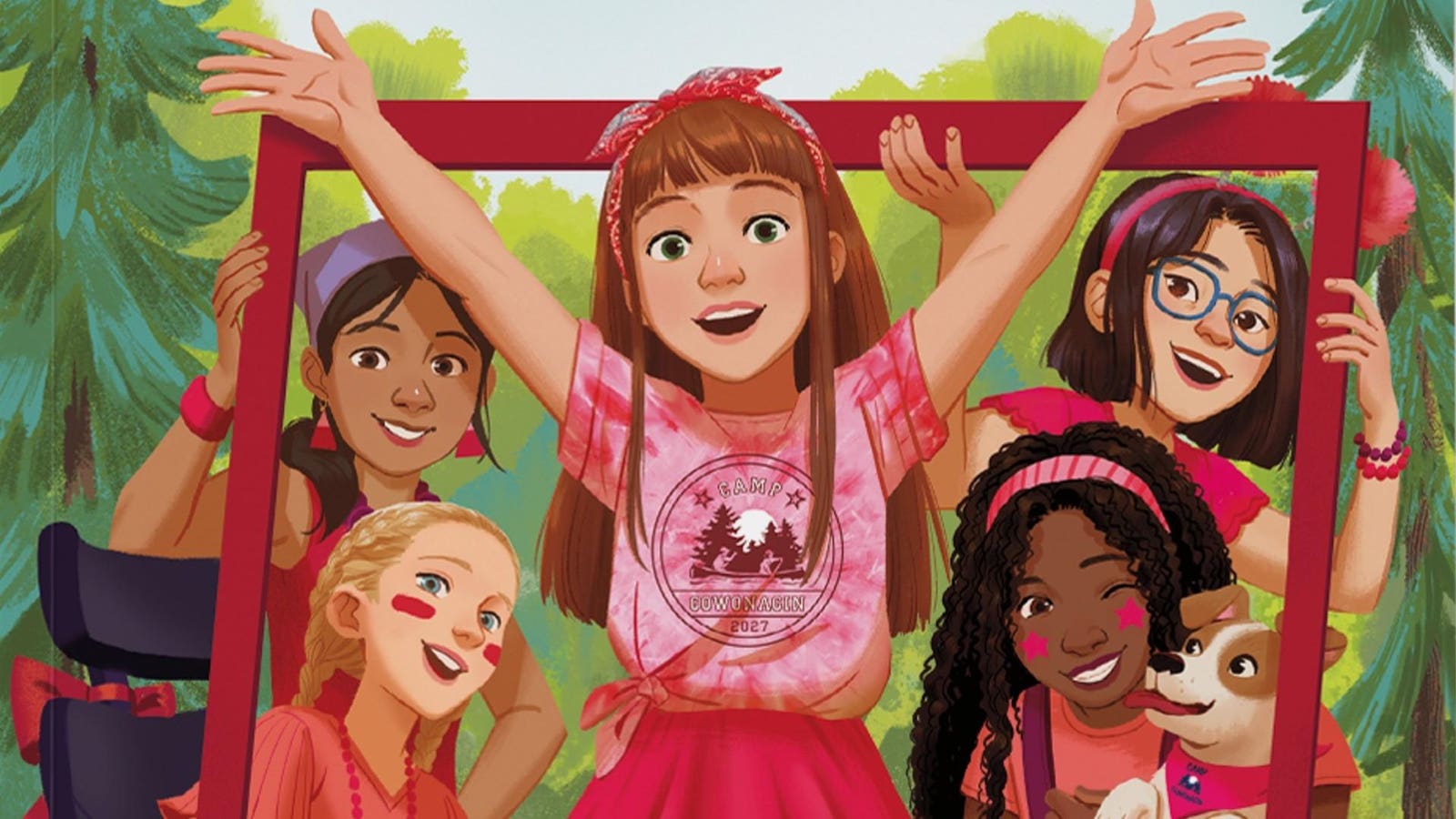
Mattel’s American Girl brand introduced Daisy Davenport as its 2027 Girl of the Year on Thursday, pairing the announcement with an immediate book release and a September doll launch. The split cadence gives the brand a six-month pre-awareness runway ahead of the holiday season, testing whether a four-decade-old franchise can convert nostalgia and new content into sustained shelf space at a time when toy companies are fighting for retailer commitment.
The companion book, Daisy Davenport Saves the Day by Megan Wagner Lloyd, is available now on the American Girl retail site. The character is an energetic soccer player headed to her first summer at Camp Gowonagin, where she must navigate homesickness after her best friend cannot attend, fear of the dark, and unfamiliar activities such as canoeing and solo night hikes. The narrative arc delivers the perseverance, kindness, and courage messaging that American Girl has used since 2001 to position the Girl of the Year line as a contemporary mirror for its young audience.
Daisy Davenport’s Book-First Launch and the Six-Month Pre-Awareness Window
The book-first, doll-later sequence is a tactic American Girl has used before. This year, the timing carries extra weight because the brand is celebrating its 40th anniversary, and the 2027 Girl of the Year is the 25th character in the annual line. By putting the story into the market months ahead of the physical product, Mattel creates a pre-awareness window that can convert to pre-orders and day-one demand when the doll lands in the fall.
The Camp Narrative as a Marketing Funnel
The plot mechanics are specific: Daisy’s best friend Callie is injured and cannot attend camp, forcing Daisy to confront the dark, canoeing, and the social friction of making new friends alone. The narrative arc ends with Daisy gaining confidence. That structure is not accidental. American Girl has consistently used the Girl of the Year line to address what it calls “relatable, contemporary experiences,” and the camp setting is a classic middle-grade anxiety vector. For Mattel, the story is the marketing funnel; the doll is the conversion event.
Why the September Doll Release Targets Holiday Inventory
A September doll release positions Daisy Davenport for the holiday shopping season, the most important revenue period for toy manufacturers. The book launch in March gives the brand roughly six months to build organic discovery through the American Girl retail site, its catalog, and its existing customer base. The gap also allows Mattel to gauge early demand signals before committing to production volumes, a non-trivial advantage in a category where inventory miscalculations can compress margins.
American Girl’s 40-Year Moat: 36 Million Dolls and a Premium Price Tier
American Girl launched in 1986 and has since sold more than 36 million dolls and introduced over 50 characters across its universe. The brand’s original historical line – dolls with period-specific backstories – created a premium price tier that separated it from mass-market fashion dolls. The Girl of the Year line, started in 2001, extended that model into contemporary settings, giving the brand an annual refresh cycle that does not require rewriting its core historical catalog.
The Anniversary as a Generational Purchase Trigger
American Girl dolls typically retail at a significant premium to Mattel’s other doll lines, including Barbie. That pricing power is supported by a direct-to-consumer retail footprint, an experiential store model, and a publishing arm that turns each character into a book series. The 40th anniversary gives Mattel a marketing hook to reintroduce the brand to parents who may have owned an American Girl doll in the 1980s or 1990s, creating a generational purchase loop that few toy brands can replicate.
Collector Dynamics and Limited-Edition Potential
Anniversary years often trigger limited-edition releases and collector-focused marketing. While Mattel has not yet announced specific 40th-anniversary product beyond the Girl of the Year line, the historical pattern suggests that special-edition dolls or re-releases of retired characters could follow. Collectors are a small but high-margin segment for American Girl, and the 25th Girl of the Year character adds a milestone layer that can be marketed to completionists.
Licensing Deals: Disney Princess and KPop Demon Hunters as Platform Extensions
In February, Mattel and Disney Consumer Products renewed a multi-year licensing agreement to produce American Girl dolls and accessories featuring characters from the Disney Princess and Disney Frozen franchises. Separately, as part of Netflix’s agreement with Mattel to make the toymaker the global master licensee for dolls and action figures based on the animated movie musical KPop Demon Hunters, American Girl dolls are being produced of the HUNTR/X singing trio of Rumi, Mira, and Zoey.
Disney Princess Renewal Signals Recurring Revenue
The Disney Princess license is one of the most durable in the toy industry. By routing it through the American Girl brand, Mattel can offer a premium-priced doll that sits above the standard Disney doll assortment. The renewal signals that the initial collaboration performed well enough for both parties to extend it, though neither company disclosed specific sales figures. For Mattel, the Disney license provides a predictable cadence of movie-driven demand spikes that the historical and Girl of the Year lines do not.
KPop Demon Hunters: A High-Risk Franchise Bet
The KPop Demon Hunters tie-in is a higher-risk, higher-reward bet. The film is an animated musical built around a K-pop group that hunts demons, a concept that blends music, action, and character-driven storytelling. American Girl’s involvement as the doll producer for the singing trio puts the brand into a franchise that has not yet proven itself at retail. If the movie performs, the doll line could capture a demographic that overlaps with the American Girl age range but skews toward music and fantasy. If it underperforms, the inventory risk is contained to a single trio of characters.
The Girl of the Year Line’s Annual Refresh and Accessory Economics
The Girl of the Year line began in 2001 and has now produced 25 characters, with Raquel Reyes as the 2026 selection. Each character is designed to reflect a specific passion or challenge – previous Girls of the Year have focused on topics such as gymnastics, animal rescue, and environmental activism. The line’s purpose, per Mattel, is to introduce girls to “a contemporary character whose experiences, passions, and challenges reflect the world around them – inspiring confidence, individuality, and imagination for a new generation.”
Daisy Davenport’s Camp Setting and Upside from Accessories
Daisy’s soccer-and-camp identity places her in the sports-and-outdoors subcategory that has performed well for American Girl in the past. The sleepaway camp setting is a classic American summer experience with broad geographic appeal. The fear-of-the-dark and homesickness themes are universal enough to resonate without being so specific that they narrow the addressable market. The choice of a camp narrative also opens accessory opportunities – bunk beds, campfire sets, canoe kits – that can lift the average transaction value.
The 25th Character Milestone and Scarcity Marketing
An annual character launch creates a natural obsolescence cycle that encourages repeat purchases. Unlike the historical dolls, which can remain in the catalog indefinitely, the Girl of the Year is positioned as a limited-time offering. That scarcity drives urgency among collectors and gift-givers. The companion book, released ahead of the doll, extends the revenue window and gives the brand a content asset that can be sold even if the doll production is delayed.
Mattel’s Entertainment Strategy and the Read-Through for MAT Stock
Mattel’s stock does not move on a single doll announcement. The company’s portfolio includes Barbie, Hot Wheels, Fisher-Price, and Thomas & Friends, among others. American Girl is a meaningful but not dominant revenue contributor. The 40th-anniversary push, however, arrives at a moment when Mattel is actively trying to demonstrate that its legacy brands can grow through content-driven licensing rather than relying solely on toy aisle foot traffic.
What the Anniversary Does Not Change
The 40th anniversary is a marketing event, not a structural change to the toy industry’s cyclicality. American Girl still competes for discretionary spending against a wide range of entertainment options for children. The brand’s premium price point makes it more sensitive to consumer confidence than mass-market toys. The anniversary can amplify demand among existing fans. It does not insulate the brand from a broader slowdown in toy spending.
September Sell-Through as the First Real Checkpoint
The next concrete marker is the September doll launch, which will give the first real demand signal for the 2027 Girl of the Year. Pre-order data, if Mattel discloses it, will be the earliest indicator. The holiday season then becomes the conversion window. Investors tracking Mattel will watch for any mention of American Girl’s performance in the company’s quarterly earnings calls, particularly the third-quarter call that covers the back-to-school and early holiday ordering period.
A strong initial sell-through of the Daisy Davenport doll, combined with positive reception for the Disney Princess and KPop Demon Hunters licensed lines, would validate the thesis that American Girl can function as a platform brand rather than a standalone story brand. Sustained growth in the American Girl segment’s revenue, which Mattel reports as part of its Doll category, would be the cleanest confirmation. If the doll launch is met with discounting shortly after release, or if the licensed dolls fail to generate incremental shelf space at major retailers, the argument that the 40th-anniversary push can reset the brand’s growth trajectory weakens. The risk is not that American Girl disappears – the brand has survived multiple toy cycles. The risk is that the anniversary year becomes a one-time bump rather than a step change in the brand’s relevance.
The Daisy Davenport announcement is a small piece of a larger Mattel puzzle. It shows a brand using its anniversary to test whether a book-first, doll-later launch cadence, layered on top of entertainment licensing deals, can stretch a premium doll franchise into new revenue channels. The September doll release will be the first real checkpoint. For broader market context, see stock market analysis.