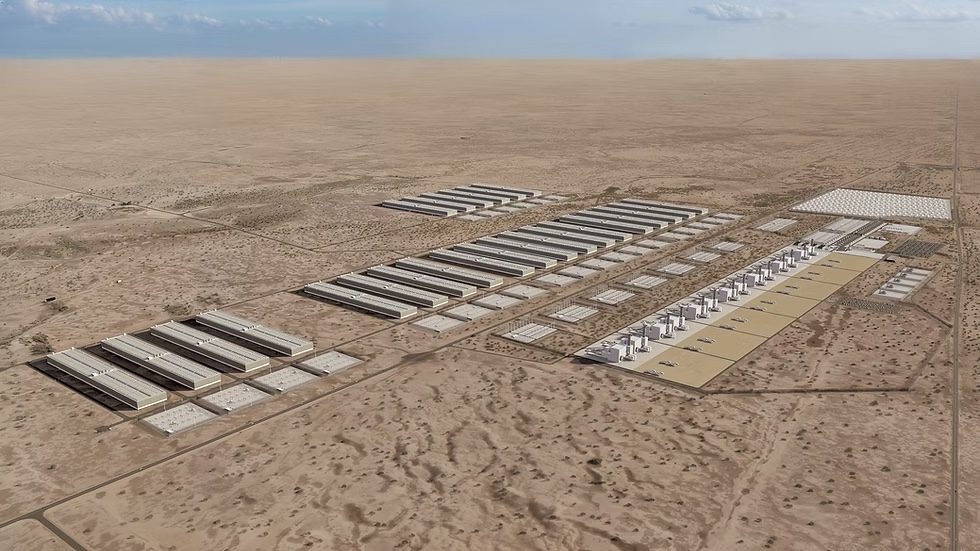
Amazon has confirmed its acquisition of GW Ranch, a west Texas hyperscale data center campus that will generate up to 7.65 GW of its own natural gas power, raising questions about the company's carbon commitments.
In August, Amazon filed building permits for three 189,000-sq-ft data center buildings on the 8,000-acre remote Pecos County campus, according to energy market research firm Cleanview Inc, which said it matched satellite images and state data and received confirmation from the tech firm.
The project, developed by California-based Pacifico Energy Group, also holds state permits for 35 natural gas turbines that can generate up to 7.65 GW of its own power, with plans for up to 750 MW of on-site solar and 1.8 GW of battery storage capacity. The developer says it will handle its own engineering, procurement, and construction for the project. Architecture firm Gensler is listed as design firm for the buildings, estimated to cost $300 million each and scheduled for completion in December. Amazon did not disclose a contractor for the buildings. Gensler has not responded to requests for comment.
GW Ranch marks Amazon's first investment in a private "behind the meter" grid data center campus. The company has not shared its planned total investment or ultimate buildout. An Amazon spokesperson said the facilities are designed around water-efficient cooling systems using non-potable sources.
"The initial phase requires no water for power-generation cooling, and later phases are designed to rely primarily on brackish groundwater, which does not compete with the community drinking water supply," the spokesperson said.
Pacifico estimated its needed investment at about $12 billion, in comments in February to Forbes. In January, Pacifico CEO Nate Franking said: "We're really excited to reach this precedent-setting milestone at GW Ranch. Demand for this intelligence will justify all the power projects underway now."
Amazon previously said it was investing a similar amount in multiple data center sites in Louisiana. Investment firm Black Rock also is leading investment efforts for at least $12 billion for a 1-GW data center project in El Paso, Texas for META, sources told The Wall Street Journal in July.
The GW Ranch gas plant could overshadow Amazon's claimed emissions-reduction accomplishments. Permitting documents specify an authorized release of more than 12,000 tons per year of regulated air pollutants, including soot, ammonia, carbon monoxide and volatile organic compounds. The complex can also release up to 33 million tons per year of greenhouse gases, documents show.
If operated at full gigawatt capacity, it could burn between 1 and 2 billion cubic feet of gas per day. That equals between 4% and 7% of all Permian Basin gas produced in 2025, according to research by the Rice University Baker Institute for Public Policy.
The facility would be allowed to produce more greenhouse gases than any other single U.S. source, according to the Texas Commission on Environmental Quality, as cited in a March letter to Pacifico from three leading Senate Democrats.
It's unclear how the project would be affected by a statewide moratorium on new data center projects, announced Aug. 3 by Texas Gov. Greg Abbott (R). Amazon is among major technology companies that have pledged to comply with the directive, which pauses projects pending audits by two state energy regulatory agencies. Data centers make up about 90% of the more than 474 GW of requests to connect to the Texas grid. The directive sets no deadline for completing the audits.
While the Amazon GW Ranch project initially will operate separately from the Texas grid, the company says the system is designed to transition to grid-connected service.
The campus is located about 30 miles from an off-grid data center complex being developed by CVX and MSFT. Set to begin operation by 2028, it will have about 2.5 GW of natural gas power, with provisions to expand to 5 GW and add solar power and battery storage.