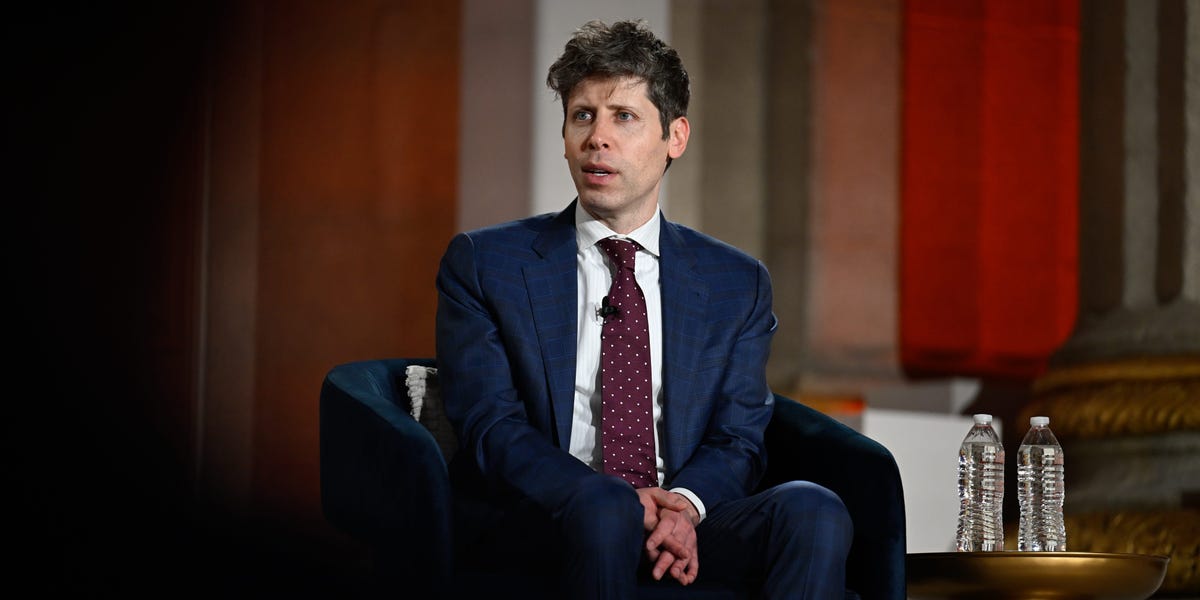
Sam Altman directly validated the biggest investor worry hanging over artificial intelligence. The OpenAI CEO told CNBC on Monday that it is fair to question whether the massive sums flowing into AI will deliver a return. He called it the "most fair criticism" of the sector.
Why Altman’s Admission Matters Now
Altman’s acknowledgment moves the AI spending debate from a theoretical risk to an acknowledged variable. OpenAI has been at the center of the capital race, raising billions and burning cash at a pace that rivals large technology companies. When the CEO of the most visible AI company says the returns are uncertain, it forces a repricing of every stock that depends on continued infrastructure investment.
The timing amplifies the effect. NVIDIA (NVDA) shares already face margin pressure from rising competition and customer concentration. Microsoft (MSFT) , Google (GOOGL) , and Amazon (AMZN) have collectively pledged hundreds of billions in data center builds. Altman’s comment gives skeptics a powerful new data point: if the person building the technology doubts the payoff, the gap between capex and revenue may be wider than the market prices.
The Mechanism Behind the AI Capex Risk
The simple read is that AI spending is a bet on future adoption. The better market read is that the spending is front-loaded into hardware, while revenue lags by years. Data center buildouts and GPU purchases are cash outflows today. The payoff depends on either enterprise adoption at scale or a breakthrough that compresses the timeline. Altman’s statement implies that even inside the leading lab, the timeline is not clear.
This creates a liquidity risk for the AI supply chain. If major cloud customers slow their GPU orders because they question internal ROI, NVIDIA could face a sharp revenue deceleration. TSM (TSM) , which manufactures the chips, would see order cuts. The entire AI hardware ecosystem relies on a belief that spending will compound for years. Altman just introduced a real possibility that it will not.
Which Stocks Are Exposed
- Microsoft (MSFT): The largest backer of OpenAI. Microsoft’s cloud revenue acceleration has been tied directly to AI inference workloads. A slowdown in OpenAI’s growth or a pivot to cost discipline would pressure the Azure AI narrative.
- NVIDIA (NVDA): The purest AI infrastructure play. Every dollar of capex uncertainty is a headwind to data center segment guidance. NVIDIA’s valuation already prices in multiple years of high growth; Altman’s remark makes that multiple harder to defend.
- Google (GOOGL): Heavily invested in TPU chips and Gemini development. Google’s AI spending is self-funded by search revenue, the same ROI question applies.
- Amazon (AMZN): AWS is building custom Trainium chips and upgrading data centers. Amazon’s capital expenditure has risen sharply, the market is watching for a sign that the spending is justified.
The exposure is not uniform. Companies with diversified cash flows, like Microsoft and Amazon, can absorb a slower AI ramp. NVIDIA has less buffer; its revenue is concentrated in data center GPUs. If the biggest customers cut orders, the stock would reprice sharply.
Decision Point: The Next Earnings Cycle
The story creates a clear decision point for watchlists. The next round of AI earnings reports – from Microsoft (late January), NVIDIA (February), and data center operators – will reveal whether capital plans are being adjusted. Any mention of spend discipline or ROI review would confirm the Altman catalyst. Conversely, a reaffirmation of aggressive buildout would weaken the bear case.
For now, the market has a new anchor: the CEO of OpenAI said the criticism is fair. That is not a sell signal by itself, it is a reason to tighten risk controls on names that depend on unchecked AI capex. The next set of earnings will tell which side of the trade is right.
For broader context on how this fits into the current market environment, see our stock market analysis. For a detailed look at the most exposed hardware name, visit the NVIDIA profile.