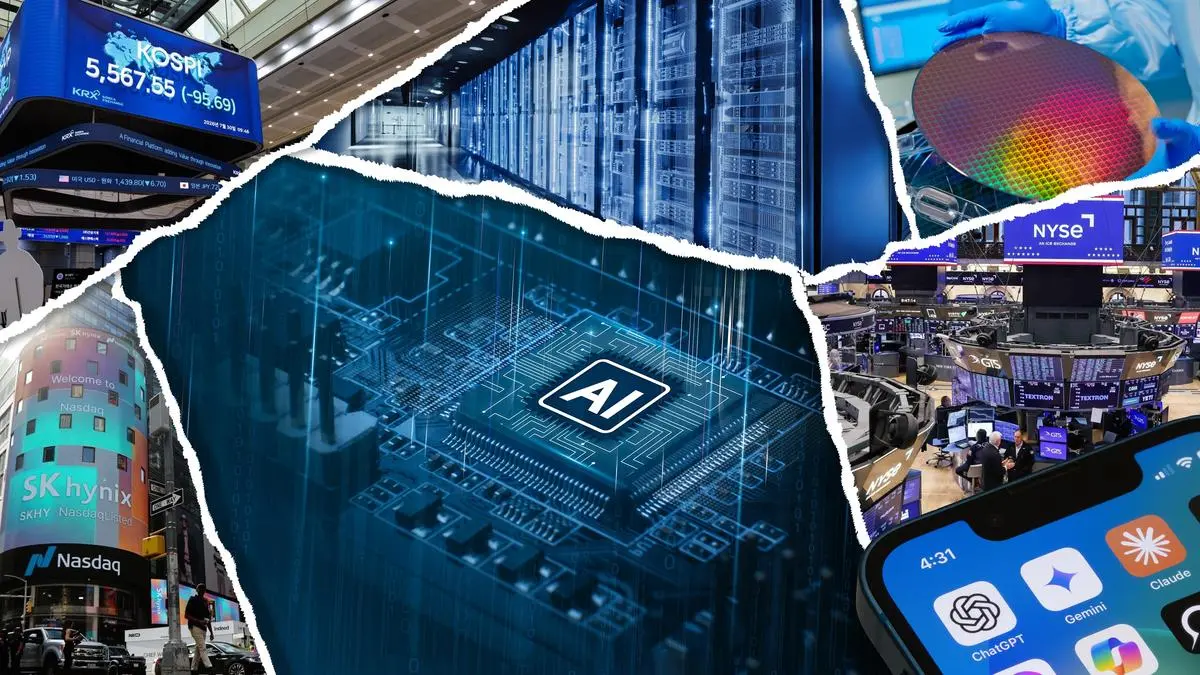
The KOSPI Composite Index suffered its worst month in decades. July's 22% loss erased $1.2 trillion in market value from the Korean stock market, a rout second only to the 27% crash during the 1997 Asian financial crisis and the 23% plunge in October 2008. Semiconductor stocks SK hynix and Samsung Electronics, which together represent roughly half of KOSPI's market capitalisation, tumbled 20% and 24% respectively from the previous week's close. The same stocks had driven the index to record highs just weeks earlier.
Single-stock leveraged ETFs amplified the pain. The CSOP SK Hynix Daily (2x) Leveraged Product ETF, for example, lost over 78% from its June 25 peak. South Korea's finance minister apologised, acknowledging that such leveraged products were introduced without careful consideration.
The unwind did not stop at the Korean border. AlphaScala examined 16 stocks spanning hyperscalers, chip designers like Nvidia and Broadcom, semiconductor manufacturers, neoclouds including CoreWeave and Nebius, and AI financier SoftBank. From their 52-week highs, these stocks are down 30% on average, having erased about $6 trillion in investor wealth. Oracle is a stark example. After its Q1 FY26 results in September, the stock surged 43% to a 52-week high. It has since corrected 62%.
Many of these stocks are in the S&P 500, accounting for roughly 30% of the index's total market capitalisation and earnings. Consensus estimates for 2026 show the S&P 500's net income rising from $2.1 trillion to $2.9 trillion, with the AI constituents contributing one in three incremental dollars. The index trades at 33 times 2025 net income, a valuation that some consider bubble territory. Based on 2026 estimates, the multiple drops to 23 times. That expected earnings growth is the dividing line between bulls and bears.
Earnings have not been the problem. The 16 AI stocks have beaten analyst estimates almost every quarter for the past four quarters. The problem is capital expenditure. Alphabet reported Q2 2026 earnings on July 22. Revenue grew 24% year-on-year, operating income 30%, and cloud revenue surged 82%. Yet the company raised its full-year 2026 capex guidance from $195 billion to $205 billion and posted its first quarter of negative free cash flow. Management said free cash flow will remain under pressure until it sees an attractive return on investment.
Meta Platforms reported Q2 results on Wednesday. Revenue beat expectations, but free cash flow amounted to just $784 million, down from $8.5 billion in Q2 2025. Amazon's Q2 results, released Thursday, showed continued negative free cash flow for the quarter. The company lifted its 2026 capex guidance from $200 billion to $220 billion.
Top hyperscalers, neoclouds, Meta, and SpaceX are expected to spend over $2.16 trillion on capex in fiscal years 2026 and 2027, according to Bloomberg consensus. That sum is roughly half the size of India's economy. The fixed asset turnover ratio of hyperscalers has been declining as capex rises.
As cash flows deplete, Silicon Valley is turning to debt. Alphabet, Amazon, Microsoft, Meta Platforms, and Oracle have raised a combined $328 billion in debt securities in 2025 and 2026 year-to-date, per Bloomberg data. That is over 45% of the total debt these companies have issued since 1997. Alphabet, which had largely avoided debt, raised about $90 billion. Amazon tops the list at $107.3 billion. Oracle and Meta each raised over $50 billion. Notably, Microsoft has not raised debt, but its cash levels have fallen to roughly 60% of what they were five years ago. Meta became a net debt company for the first time since its 2012 listing in 2025.
Nvidia, which had never generated negative free cash flow since fiscal 2009, issued $25 billion in debt securities in 2025-26. SoftBank Group, which has invested over $30 billion in OpenAI and committed $30 billion more, approached a consortium of lenders for a $10 billion loan backed by its stake in OpenAI. Bloomberg later reported that the loan attempt stalled, with the requirement downsized to $6 billion.
S&P downgraded Oracle's long-term credit rating to BBB-, one notch above junk. Credit default swap spreads for Oracle are now higher than the 211 basis point peak during the 2008 financial crisis.
A Nikkei Asia study revealed that off-balance-sheet debt for Alphabet, Amazon, Microsoft, Meta, and Oracle reached a combined $1.65 trillion, exceeding the $1.35 trillion of transparent debt on their balance sheets. After recent earnings, the hidden debt figure stands at $2.5 trillion. This hidden debt largely consists of lease commitments to data centre operators, semiconductor purchase agreements, and energy service contracts, often running until 2030. Many contracts are negotiated on a take-or-pay basis, meaning the companies must pay regardless of whether they use the product or service.
Companies also report remaining performance obligations, or revenue backlog, which measures future cash inflows. A large portion of that backlog is concentrated in two customers: OpenAI and Anthropic. They account for roughly 41% of Microsoft's RPO, 47% of Oracle's, 38% of Google's, and 48% of Amazon's. Both OpenAI and Anthropic are cash-burning companies whose business models face increasing competition from cheaper open-source models. The Chinese AI lab Moonshot recently released Kimi K3, an open-source large model seen as a serious contender to the top-tier proprietary models. Token costs have been declining, as shown by Silicon Data's LLM Token Expenditure Index. Sam Altman recently announced token price cuts for some OpenAI models.
Memory stocks also took a hit. Micron, SK hynix, and Samsung each fell over 20% during the week, reacting to the blockbuster IPO of Chinese DRAM supplier ChangXin Memory Technologies. The $8.6 billion IPO proceeds could help CXMT add capacity, increasing supply and pressuring margins. The three stocks recouped most of the losses by the end of the week.
AlphaScala's Alpha Score for NVDA stands at 72, reflecting a moderate rating, while MSFT scores 69.
As Steve Eisman of The Big Short fame recently said, what scares him is that the whole US market is all one AI trade, so it better succeed.