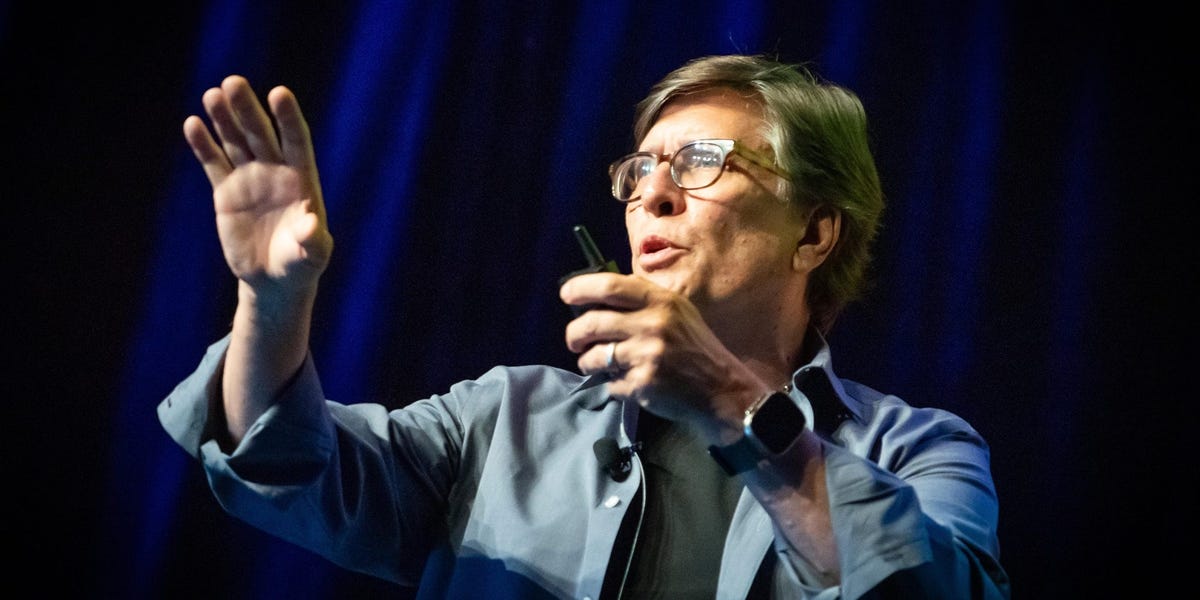
John Nosta, an innovation theorist and founder of the think tank Nostalab, sees a growing risk in the rise of polished AI. He worries the technology could slowly crowd out the rare, original thinking behind humanity's biggest breakthroughs.
Nosta compares human thinking to a bell curve. Most people cluster in the middle, he said. The people responsible for breakthroughs sit at the extremes, or what he calls the "tails."
"What we're seeing is that large language models, particularly when they train themselves on what's called recursive data – that is, data generated by AI itself – that bell curve starts to change," Nosta told Business Insider.
"We lose the tail. It just becomes one big bump," he said. "What happens there is that it sort of blends into a sea of mediocrity."
He described Albert Einstein and Isaac Newton as tails – the outliers who changed how we see the world.
"Where's the outlier? Where's the weird idea? Where's the person who sees something nobody else sees? That's what concerns me," he said of AI.
Recursive AI systems, Nosta argued, gravitate toward consensus instead of originality. The technology pushes unconventional thinking to the middle, making it harder for strange ideas to emerge.
"Those strange ideas get pushed toward the middle because the computational dynamics of the AI push those strange outliers away," he said.
Nosta does not think AI will eliminate creativity. He thinks it could make originality rarer by nudging people toward the same patterns of thinking.
"Society depends on those outliers," he said.
Not everyone shares the same concern. Jill Kramer, chief marketing and communications officer at Mastercard, said AI can serve as "an engine for human creativity." The technology helps marketers generate deeper insights and broaden the research that fuels new ideas, she said. Kramer told Business Insider AI allows teams to do things they "could never do before."
Chris Best, CEO of Substack, has said AI could flood the internet with "AI slop" and also usher in a future with more creative leverage for independent creators.
Nosta offers a middle path. He advocates using AI as an "iterative intelligence" partner, one that helps people explore ideas rather than replace the thinking process. Vivienne Ming, chief scientist at the Possibility Institute, has promoted a similar idea. She told Business Insider in March that AI is most valuable when people use it to challenge their own thinking, creating what she calls "productive friction."
"The iterative engagement is where we need to celebrate this," Nosta said.
For companies that depend on innovation, the balance between AI-driven efficiency and preserving original thinking is a strategic question. Mastercard, rated Moderate with an Alpha Score of 71 by AlphaScala, sits at that intersection. The technology can boost productivity. The risk of homogenized ideas could affect long-term innovation in sectors that rely on breakthroughs.
To Nosta, preserving originality comes down to habits AI cannot replicate: curiosity, struggle, and the willingness to think differently.
"The treasure is in the tail," he said.