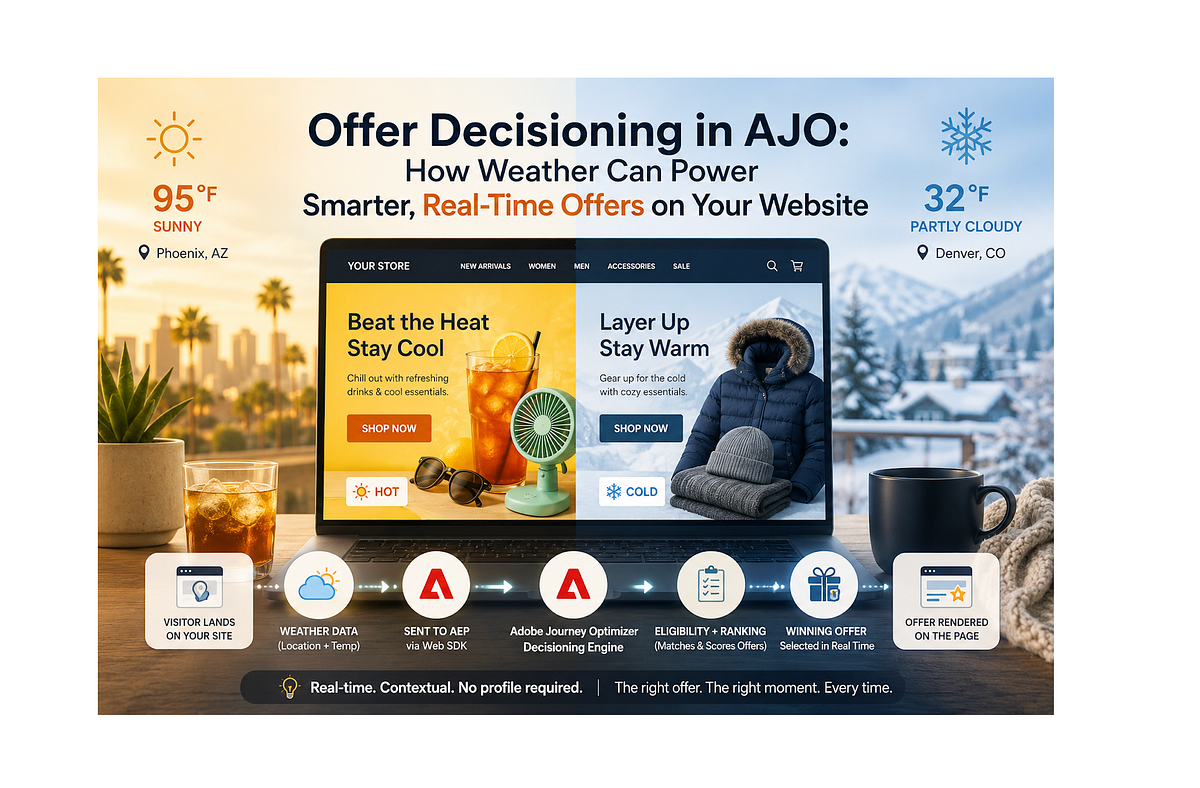
Adobe published a blog post and a working demo this week showing how Journey Optimizer's offer decisioning engine can swap website offers based on live weather data. A visitor in a 95°F zone sees a banner for iced drinks and fans. Someone in a 45°F zone sees a jacket promotion. The entire handshake happens in-session, with no customer profile required.
The mechanism is simple. The webpage asks for location permission, fetches the current temperature, and passes that context into Adobe Experience Platform through the Web SDK. Journey Optimizer evaluates offers tagged with conditions like "hot," "spring," or "cold" and renders the best match. The thresholds are configurable per business.
The architectural implication is what matters for the marketing technology sector. AJO's decisioning engine is designed to work off any context passed at the moment of request, not just profile attributes. That means a company can personalize on signals like time of day, device type, page content, or ambient weather without waiting for a customer record to populate. The blog post makes this point explicitly: "Offer decisioning in AJO doesn't demand a profile to do its job."
For Adobe, this is a direct play into the widening gap between profile-heavy personalization and lightweight, contextual personalization. Rivals like Salesforce Marketing Cloud and HubSpot have similar real-time decisioning capabilities. Adobe's advantage lies in the tight integration between AJO, AEP, and the Web SDK – a stack that can ingest external APIs and act on them within the same session. The weather demo is a proof point for that pipeline.
The broader readthrough for the martech sector is about architecture. Most personalization platforms still default to profile-driven segmentation. Adobe is betting that a growing number of use cases – flash sales, local events, inventory-driven offers – will be better served by in-session context than by historical data. The blog post frames this as a mindset shift: "Sometimes the right move is deep profile-based personalization. Sometimes the right move is something far lighter."
A retailer in Phoenix and a retailer in Minneapolis would draw their temperature bands differently. That is fine. The architecture supports custom thresholds per business. The practical limit is how many external signals a company wants to wire in, not how the engine resolves offers.
Adobe has published a working demo of the weather-based offer setup. For anyone tracking the martech ecosystem, the question is less about weather data and more about which other real-world signals – traffic, inventory, competitor pricing, local events – will get the same treatment in the coming months. The engine already handles them. The adoption curve is about integration effort, not technical feasibility.