Macro● Neutral
30-Year Yield Hits 5.28% as Bond Bear Market Enters Sixth Year
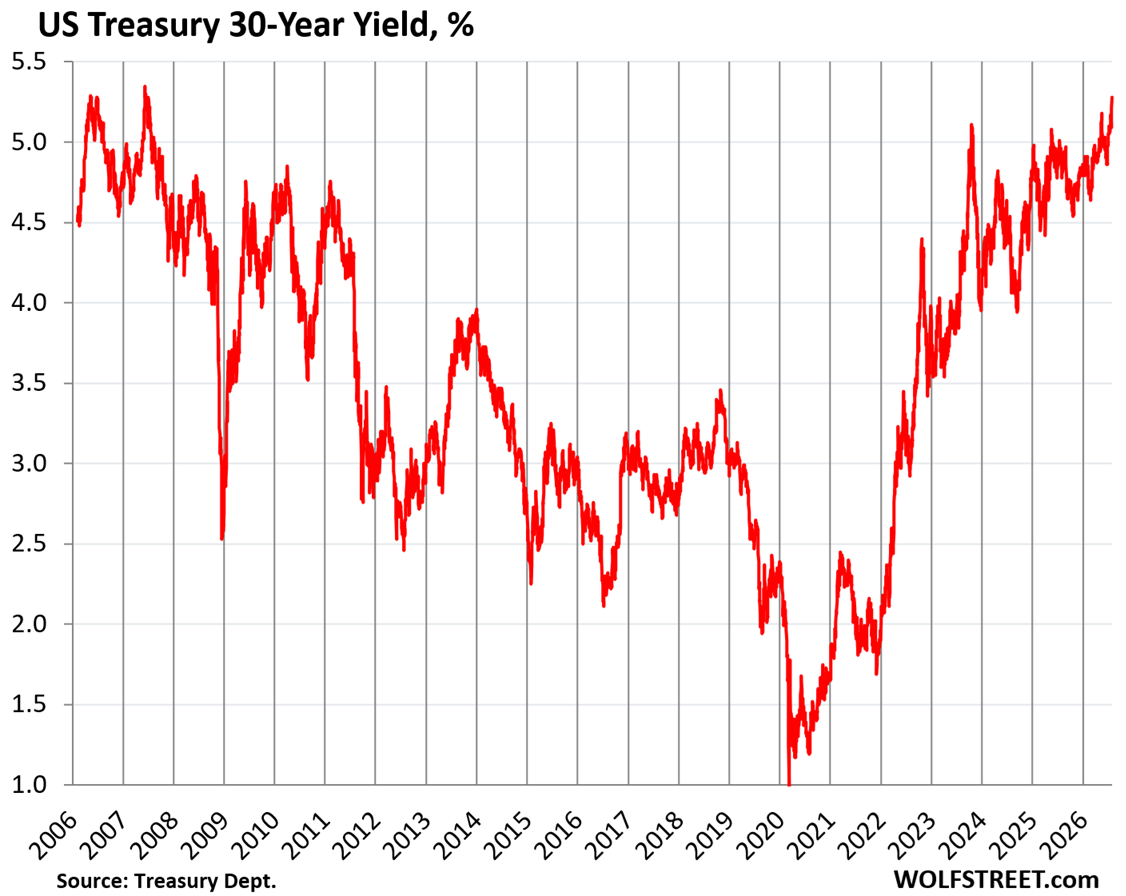
Fed Chair Warsh praised the bond market for finally looking at data, not the Fed, as the 30-year yield surged to 5.28%, the highest since 2006.
Continue with
The 30-year Treasury yield jumped 7 basis points Friday and 12 for the week, hitting 5.28% – the highest since July 2006. That puts it 165 basis points above the effective federal funds rate, the rate the Fed targets with its policy tools.
Fed Chair Kevin Warsh used the FOMC press conference Wednesday to praise the bond market for finally looking at economic data and not at the Fed. He said ending “forward guidance” was already working. Treasury yields had surged since the June meeting, when forward guidance ended, as markets began to focus on data. Buyers and sellers were raising rates and tightening financial conditions, Warsh said, and this “has provided us some comfort that we’ve got the ability and capability to deliver.” In his telling, the bond market was finally doing its job.
That job has been brutal for holders of long-dated Treasuries. The market value of 30-year bonds sold at auction in mid-2020 has plunged about 50%. Investors who bought then can hold to maturity and get their money back in 24 years, but they collect only 1.3% a year in interest. Current buyers earn 5.28%. The difference is the cost of believing the old forward guidance.
Warsh scuttled forward guidance early in his tenure. He had blasted the Fed for locking itself in as inflation surged toward 9% in 2021 while rates sat at zero and QE ran full tilt. When the Fed finally tightened, it was too late. Some banks that had loaded up on long-term Treasuries and MBS in 2020 and 2021 collapsed in 2023. Warsh told the bond market to figure things out on its own. Now buyers and sellers react to inflation and supply data, not to the Fed.
The 10-year yield rose 7 basis points Friday to 4.75%. It briefly hit 5% during the debt scare in October 2023, and that level opened the floodgates of demand, pushing yields back down. There is no guarantee the same floodgates open at 5% again. The 10-year at 4.75% is not historically high – it was pushed to very low levels by the Fed's interest-rate repression and QE starting in 2008. Now inflation is out of the bottle, and the Fed cannot do QE in this environment. Warsh wants to shrink the Fed's balance sheet further to help bring down inflation, the opposite of QE, which could put upward pressure on long-term yields. At Wednesday's meeting, he did not have a majority for anything beyond maintaining the status quo.