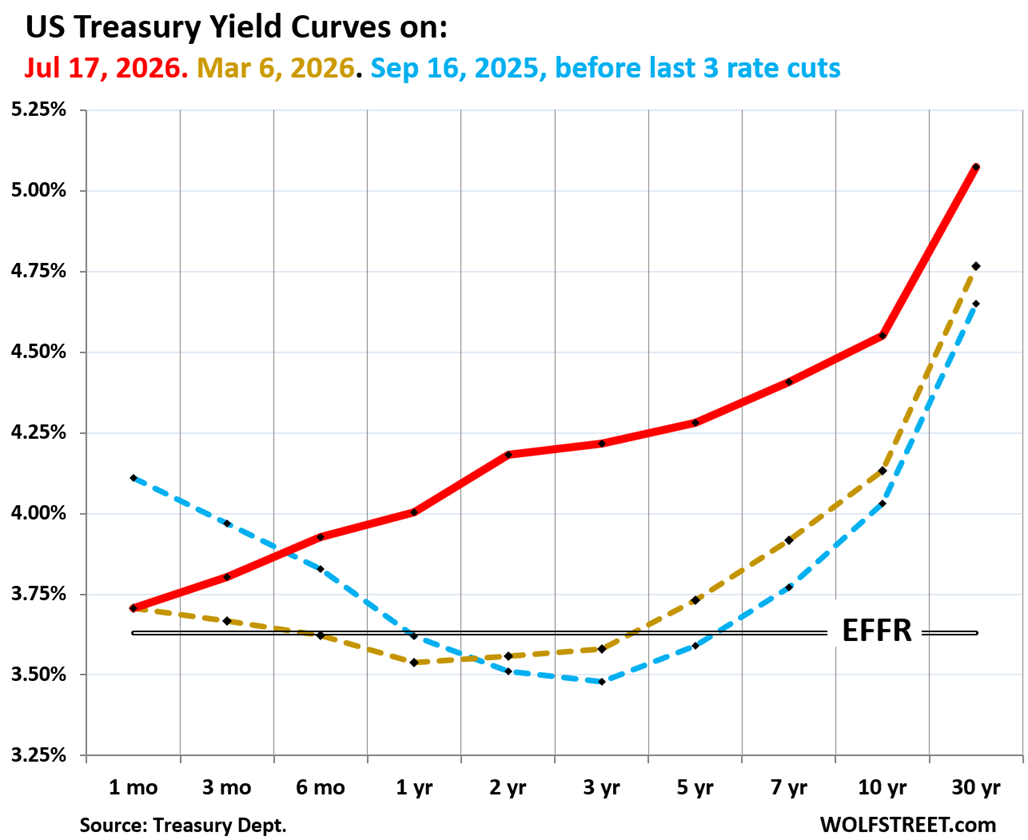
The 30-year Treasury Inflation-Protected Security yield closed at 2.91% on Friday, the highest since the government reintroduced the inflation-protected bond in February 2010. The regular 30-year Treasury yield held at 5.06%, near the top of its post-2006 reintroduction range.
The yield curve now points to further tightening. The 6-month Treasury yield sits 30 basis points above the effective federal funds rate, a gap that historically precedes a Fed rate increase. The 2-year yield also signals a second hike next year, while longer-term yields have pushed higher on inflation concerns.
TIPS holders receive a fixed coupon on a principal that grows with CPI. The 2.91% yield is paid on top of that inflation adjustment. If CPI averages the Fed's 2.15% target, a TIPS buyer today earns a combined 5.06% – matching the regular 30-year bond. If inflation runs at 3.5%, the return jumps to 6.41%. If it falls to 1%, the return drops to 3.91%. The regular bond buyer gets 5.06% regardless.
The TIPS market is small. Only $2.16 trillion in TIPS of all maturities are outstanding, 6.8% of total marketable Treasury securities. The Fed still holds $380 billion, or 17.6% of the market, a remnant of its pandemic-era quantitative easing. That program pushed the 30-year TIPS yield to negative 0.6% by the end of 2021. When the Fed tapered QE and then started quantitative tightening, the TIPS yield soared.
For earlier buyers, the rally in yields has been brutal. Consider the 30-year bond issued in August 2020 at a 1.406% yield. It now trades at roughly 48 cents on the dollar. Investors who bought at that auction and sold today would take a 52% capital loss. The 2023 collapse of several regional banks, including SVB, stemmed from their reliance on the Fed's 2020-2021 forward guidance that rates would stay near zero. Those banks loaded up on long-term Treasuries and mortgage-backed securities, then blew up when yields surged.
New buyers face a different calculation. The same August 2020 bond, purchased today at $480 per $1,000 face value, offers a yield to maturity of about 5.24%, according to online calculators. Annual coupon payments are $14.06, and the bond matures in August 2050 with a $520 capital gain. The trade-off: low current income for a large future gain.
The yield curve on Friday showed the 1-month yield still anchored by the Fed's current policy rate of 3.50% to 3.75%. Beyond that, the curve steepens. The 6-month yield at 30 basis points above the effective federal funds rate signals that the market expects a rate increase in the next few months. The 2-year yield points to another hike next year. Long-term yields have risen substantially on inflation fears.
The next scheduled data that could move the curve is the Fed's Beige Book and the April employment report. Until then, the bond market's message is clear: the era of low rates is over, and the Fed may need to tighten further to contain inflation.