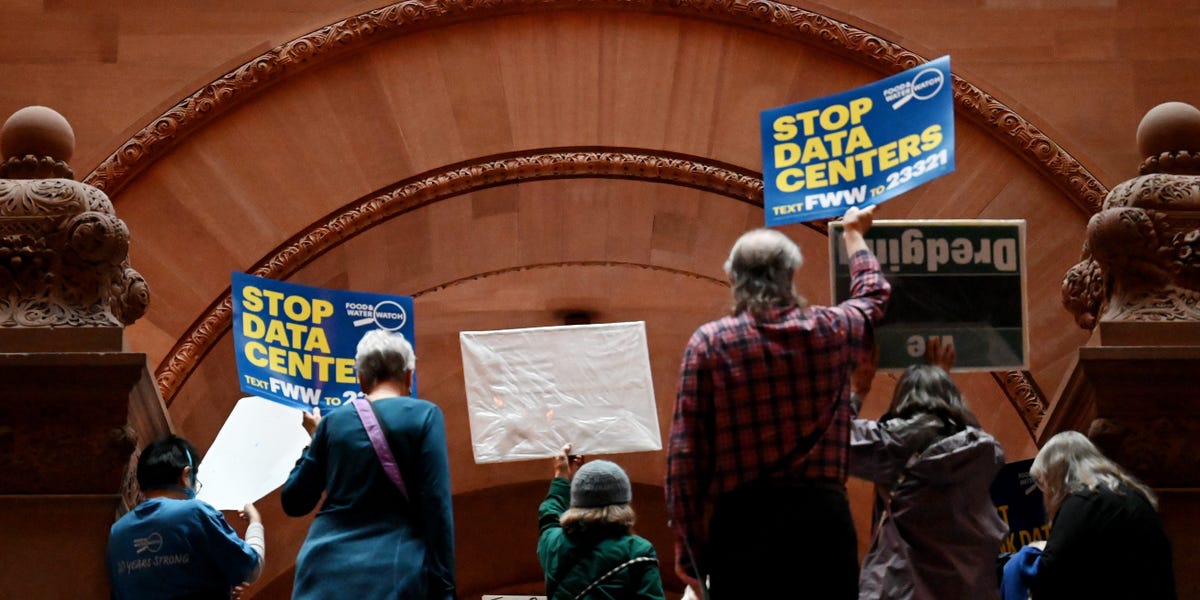
More than 200 data centers are under construction or planned across dozens of competitive House districts, a POLITICO analysis shows. Neither party has settled on a message for the local backlash that is building.
The political collision comes at a moment when data center demand is surging. Hyperscalers and colocation providers have been racing to secure power and land. Now those projects sit inside districts where every vote counts. Local opposition over electricity consumption, water use, and noise has already slowed or killed projects in Virginia, Arizona, and Oregon. The midterm cycle will amplify those fights.
For investors, the risk is not that data center construction stops. It is that the timeline stretches. A project that needed 18 months for permitting could take 24 or 30 months if local candidates campaign on blocking it. That delay hits revenue forecasts for REITs like Equinix and Digital Realty, which depend on steady lease-up schedules. It also pressures the supply chain for electrical equipment and cooling systems, where lead times are already long.
The POLITICO analysis did not name specific companies. The geography is telling. Competitive districts in the Midwest and Southwest have attracted large campuses because of cheap power and available land. Those are also districts where a single zoning board decision can become a campaign ad.
Neither party has a playbook. Democrats worry about environmental and labor pushback from their base. Republicans face tension between business-friendly rhetoric and local NIMBY sentiment. The result is uncertainty. A candidate who promises to block a data center could win a primary but lose a general election if the project meant jobs. The calculus is messy.
What changes next is the pace of new announcements. Developers will think twice before breaking ground in a district where the incumbent is vulnerable. They may shift capacity to states with fewer competitive races or to sites already permitted. That creates a bifurcation: projects in safe districts proceed; projects in swing districts stall.
The midterms are in November 2026. Between now and then, every local zoning hearing in a competitive district becomes a data point. Investors should track the number of projects that enter the permitting pipeline, not just the total under construction. A drop in new applications would signal that political risk is materializing.
For now, the data center build-out remains on a strong footing. The POLITICO analysis counts more than 200 facilities in play. The question is how many of those actually get built on schedule.