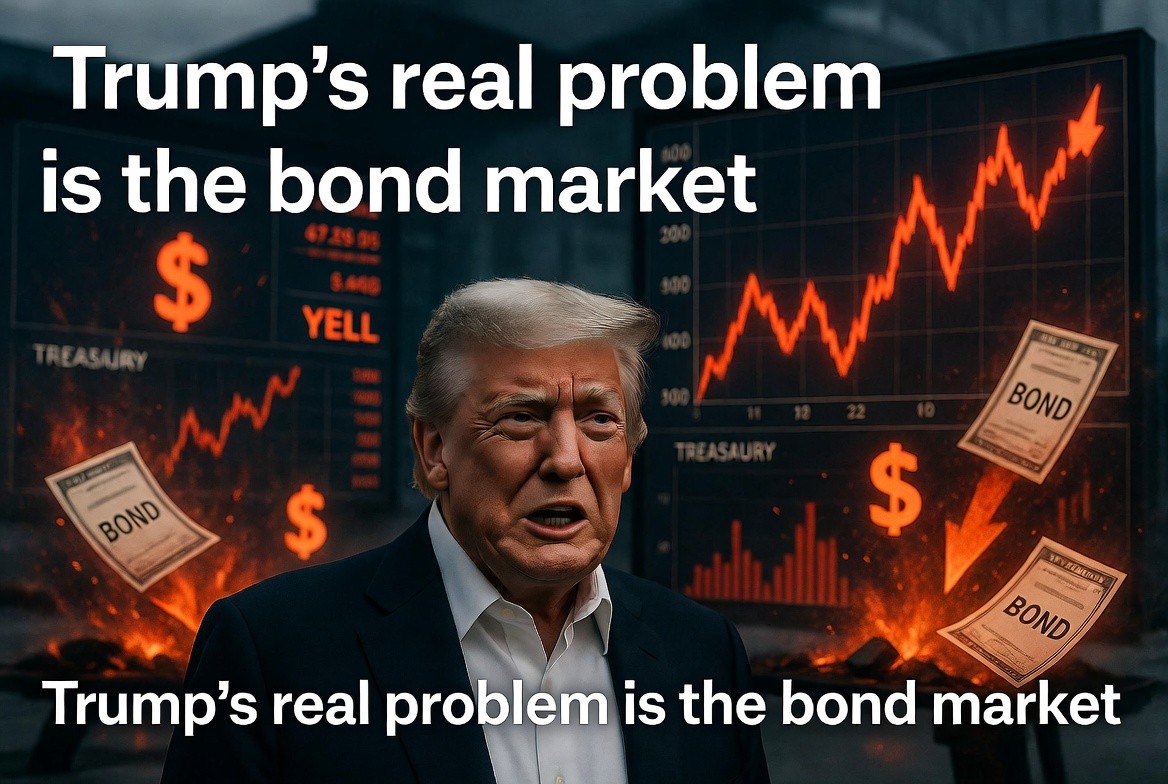
The benchmark US 10-year Treasury yield has climbed to 4.631%, its highest level since February 2025. The 30-year yield briefly touched 5.16% – near three-year highs – while the two-year yield rose above 4.1%. This is not a routine backup in rates. It is the opening phase of a regime shift that directly threatens the stock market rally Donald Trump has championed throughout both his presidencies.
The immediate trigger is oil. Brent crude surged past $110 a barrel as conflict around the Strait of Hormuz escalated. The corridor carries roughly 20% of global oil supply. A sharp repricing across energy markets has reignited inflation expectations, and bond investors are demanding more compensation to hold long-dated government debt.
Nigel Green, CEO of deVere Group, puts it directly: “Trump has always understood the political power of rising stock markets. Strong equities project confidence, momentum and economic success. Bond markets are beginning to overpower the stock market narrative.”
For traders, two big questions follow. First, how much further can yields rise before equity valuations break? Second, what is the White House’s exit path from the Iran trap?
10-Year Yield at 4.63%: The Discount Rate Returns
The simple read is that higher oil leads to higher inflation, and higher inflation leads to higher nominal yields. That is accurate but incomplete.
The better market read involves asset allocation. For more than 15 years, investors had little alternative to equities because sovereign yields were artificially suppressed and cash generated almost nothing. That environment supported extreme valuations across tech and growth assets. Now a 10-year Treasury yielding above 4.6% offers a risk-free hurdle that many growth stocks cannot clear.
Green explains the mechanism: “Investors, for years, had little alternative to stocks because sovereign yields were artificially suppressed and cash generated almost nothing. That environment supported extreme valuations across tech and growth assets. Now investors can earn above 5% in long-dated Treasuries with materially lower risk than many sectors of the stock market currently priced for perfection. That changes asset allocation globally.”
Equity traders who ignore the 4.6% risk-free rate are disregarding the biggest regime shift in 15 years. The higher yields go, the harder it becomes to justify future cash flow assumptions on expensive technology companies.
Brent at $110 and the White House Trap
Brent crude at $110 is not a temporary spike. It reflects real physical disruption risk. The escalation around the Strait of Hormuz forces the White House into two deeply uncomfortable outcomes, according to Green:
- Escalate aggressively: markets fear a deeper oil shock that drives inflation and bond yields even higher.
- Step back: investors face a prolonged regional conflict that keeps energy prices elevated for months.
“Neither outcome is particularly supportive for equities,” Green says.
This is a supply shock the Federal Reserve cannot offset. Any attempt to ease policy would risk embedding higher inflation expectations, which would push long-term yields even higher. The oil market is now the key input for the bond-equity correlation. Oil-driven inflation hurts both bonds and growth stocks simultaneously. That correlation has re-emerged after months of decoupling.
The risk is concentrated in energy-dependent sectors and countries. For context, our earlier analysis of the Strait of Hormuz inventory risk is here: IEA Warns Oil Inventories Near Depletion as Strait of Hormuz Closes. And the downstream effects on oil-sensitive equities are covered in Valvoline (VVV) Leads Broyhill as Crude Risk Looms.
Debt Credibility Beyond the Fed – Japan’s 30-Year Yield Tops 4.2%
Green argues the issue now extends beyond the central bank. It is a debt credibility story as much as an inflation story.
“The US is running enormous deficits while refinancing costs are climbing sharply,” he notes.
The mechanical feedback loop is clear: higher yields on new issuance raise interest expense, which widens deficits, which may require more issuance, which pushes yields higher. That is not a theoretical risk. It is visible in Japan, where the 30-year government bond yield moved above 4.2% for the first time on record as Tokyo prepares additional borrowing linked to wartime fiscal pressures.
| Bond Market | Yield | Context |
|---|
| US 10-year | 4.631% | Highest since February 2025 |
| US 30-year | 5.16% (briefly) | Near three-year highs |
| US 2-year | Above 4.1% | Two-year high |
| Japan 30-year | Above 4.2% | First time on record |
This is not a US-only phenomenon. Major developed market yields are repricing higher in sync. The global backup raises the bar for equity valuations everywhere.
The Tech and AI Rally Masks Growing Fragility
Green flags that the AI and tech rally masked weakening market breadth. A narrow set of mega-cap companies drove indices higher while underlying market breadth deteriorated. Growth stocks are long-duration assets that depend on cheap capital and distant future earnings assumptions.
A higher risk-free rate reduces the present value of those earnings. The higher yields climb, the greater the adjustment in tech and AI stocks.
“A relatively small number of mega-cap companies have carried US equities higher while underlying market breadth weakened. Higher bond yields expose that vulnerability very quickly because expensive growth stocks depend heavily on cheap capital and future earnings assumptions. The higher yields go, the harder those valuations become to sustain,” Green says.
This is not a simple value rotation. In a rising yield regime driven by oil and deficits – not growth – value sectors with debt exposure also suffer. The broad-based risk is equity-wide.
Key insight: Bond markets, not the Fed, are now the primary constraint on equity valuations. The 4.6% risk-free rate reprices every future cash-flow assumption.
What Confirms the Regime Shift – and What Would Break It
What confirms the risk scenario: The 10-year yield breaking above 4.7% and Brent staying above $110 into the next month. That would trigger equity volatility and a flight from expensive growth into cash or short-duration instruments. The cost of carry for leveraged positions would increase, compressing speculative capital.
What would ease the risk: A diplomatic resolution that reduces the Strait of Hormuz risk premium, or a sharp slowdown in economic data that pulls yields lower despite inflation. Neither looks imminent given the White House trap – escalation or prolonged conflict are the two paths Green outlines.
For now, the bond market is dictating the direction. Investors who rely on the old post-2008 playbook – cheap money, suppressed volatility, endless liquidity – are facing a different reality. “Bond markets are beginning to dismantle the assumptions that supported the entire post-crisis bull market,” Green warns.
The practical takeaway: track the 10-year yield and Brent crude as the two leading indicators. If yields stay above 4.6% and oil above $110, the equity risk premium is shrinking daily. The stock rally Trump has championed depends on a bond market that is no longer cooperating.
For broader context on commodity-driven macro moves, see our commodities analysis section. For direct exposure to oil price dynamics, the crude oil profile is a starting point. Traders should also evaluate their broker’s capacity for handling volatile energy markets – our guide to best commodities brokers covers the key criteria.