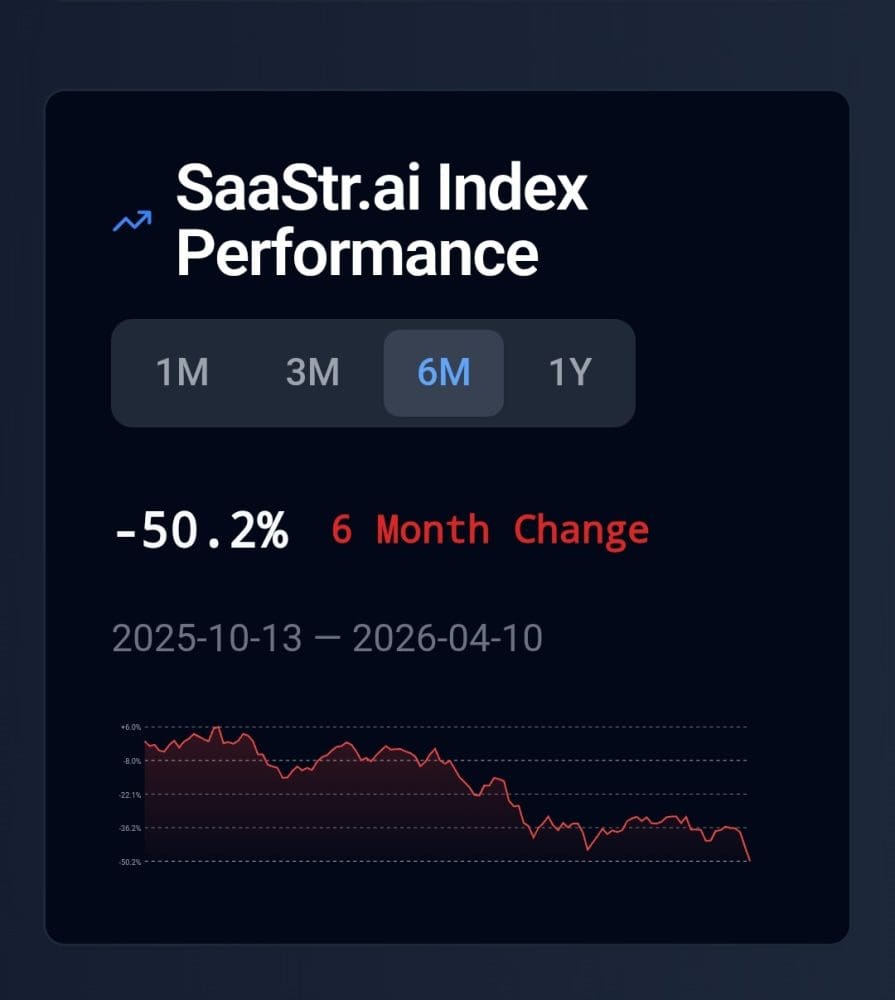
A Brutal Half-Year for Cloud Sovereigns
The once-invincible B2B software sector has faced a catastrophic repricing over the past six months, with the SaaStr.ai Index—which tracks the top 25 public software companies—recording a staggering decline of 50.5%. The period from October 2025 to April 2026 has effectively wiped out half of the market capitalization of the industry’s most prominent players, signaling a definitive end to the era of "growth at any cost" valuations that defined the post-pandemic tech boom.
For investors and traders, this isn't merely a correction; it is a fundamental reassessment of how the market values recurring revenue models in a high-interest-rate environment. The index’s slide highlights a broad-based evaporation of sentiment that has spared few, if any, of the sector's stalwarts.
The Anatomy of the Sell-Off
The B2B software landscape has long been a favorite for institutional capital, prized for high gross margins, predictable churn rates, and massive scalability. However, the current drawdown reflects a jarring shift in macroeconomic priorities. As capital costs have remained elevated, the market has pivoted aggressively toward profitability and cash-flow efficiency.
Companies that were previously rewarded for triple-digit top-line growth are now being penalized for failing to demonstrate clear paths to GAAP profitability. When an entire sub-sector of the top 25 firms loses half its value in 180 days, it suggests that the market is no longer pricing these firms based on their potential to disrupt, but rather on their resilience in a tightening credit cycle. This 50.5% haircut serves as a stark reminder that even the most "sticky" enterprise software models are not immune to the gravity of market-wide valuation compression.
Market Implications for Traders
What does this mean for those navigating the current volatility? First, the disparity between high-quality software firms and their over-leveraged peers has widened. Traders should look for divergence in how individual companies within the index are managing their burn rates.
Historically, such deep drawdowns in technology indices have often been followed by a period of M&A activity. As public valuations crater, private equity firms and legacy tech giants with massive cash piles are likely to view these discounted software assets as prime consolidation targets. Investors looking for a floor in this sector should monitor for signs of "capitulation volume"—where the selling intensity finally exhausts itself—and watch for companies that have managed to maintain double-digit revenue growth while simultaneously achieving positive free cash flow.
The Road Ahead: What to Watch
The software sector is currently in a "show me" phase. Investors are no longer interested in future-dated promises or aggressive total addressable market (TAM) projections. Instead, the focus has shifted entirely to the next two to four quarters of earnings reports.
Moving forward, the primary catalysts for a potential recovery will include:
- Margin Expansion: Evidence that companies can scale without ballooning their operating expenses.
- Retention Metrics: Stability in net revenue retention (NRR) rates despite enterprise budget tightening.
- Macro Pivot: Any shift in central bank policy that signals lower borrowing costs could provide the necessary tailwind for high-growth tech multiples to expand once again.
As of April 2026, the software sector remains under intense pressure. While a 50% decline may suggest the worst of the panic is priced in, the path to recovery will likely be slow, characterized by a sector-wide "flight to quality" that prioritizes disciplined balance sheets over speculative growth.