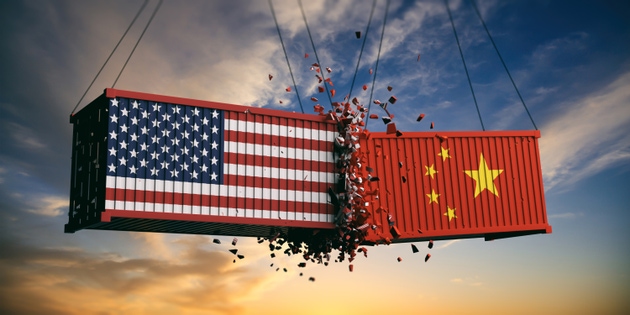
Escalation on Two Fronts
In a dramatic escalation of U.S. foreign policy that has sent shockwaves through global commodity markets, President-elect Donald Trump has issued an ultimatum to Beijing, threatening to impose a 50% tariff on Chinese goods. The proposed levy is explicitly linked to China’s continued economic support for Iran. Simultaneously, reports indicate that the incoming administration has ordered the U.S. Navy to prepare for a potential blockade of the Strait of Hormuz—the world’s most critical maritime chokepoint for energy supplies.
These dual threats represent a significant hardening of the U.S. stance on international trade and regional security. For global markets, the news acts as a double-edged sword: the tariff threat risks reigniting trade wars and disrupting global supply chains, while the naval blockade of the Strait of Hormuz threatens to choke off nearly 20% of the world’s total crude oil consumption.
The Energy Market Reaction
Crude oil prices spiked immediately following the news, reflecting the heightened risk premium now being priced into the energy sector. The Strait of Hormuz is a vital conduit for oil exports from Saudi Arabia, the UAE, Kuwait, and Iraq. Any disruption to tanker traffic in this region is widely viewed by analysts as a ‘black swan’ event capable of pushing oil prices to levels not seen in years.
“The market is essentially pricing in a worst-case scenario,” noted one market analyst. “When you combine the potential for a massive, broad-based tariff on the world’s second-largest economy with the literal throttling of global energy transit, the probability of a systemic supply-chain shock increases exponentially.”
Macroeconomic Implications: The Specter of Stagflation
For investors, the primary concern is the potential for a return of stagflationary pressures. A 50% tariff on Chinese imports would likely result in immediate inflationary spikes in the United States, as the cost of consumer and industrial goods rises sharply. When coupled with higher energy costs resulting from a potential blockade, the Federal Reserve’s path to a ‘soft landing’ becomes significantly more treacherous.
Economists are already warning that these developments could trigger a recession. The combination of increased import costs and energy volatility acts as a tax on both the consumer and corporate sectors. If these policies are enacted, businesses may be forced to pass on higher costs, leading to a contraction in consumer spending and a potential downturn in corporate earnings across the S&P 500 and global indices.
Trader Outlook: What to Watch
As the situation develops, volatility across all asset classes is expected to remain elevated. Traders are advised to monitor several key indicators in the coming sessions:
- Crude Oil Spreads: Look for a widening in Brent and WTI futures as the market attempts to quantify the risk to Middle Eastern supply.
- Safe-Haven Currencies: A flight to safety may benefit the USD and CHF as investors pull capital from emerging markets and export-heavy economies.
- Trade-Sensitive Equities: Companies with significant exposure to Chinese manufacturing and supply chains will likely face massive downward pressure as the 50% tariff threat looms.
The Path Ahead
Whether these threats serve as a negotiating tactic or a precursor to actual policy remains the central question for the market. However, the sheer scale of the proposed 50% tariff and the strategic gravity of a blockade in the Strait of Hormuz suggest that the administration is prepared to trade market stability for long-term geopolitical objectives. As the transition period continues, market participants should prepare for a period of extreme, headline-driven volatility where traditional technical analysis may be superseded by rapid shifts in geopolitical sentiment.